This route is for anyone who wants to walk the Jewish quarter on their own without missing the essentials. It is not an inventory — the honest inventory of what remains is in Barrio de Santa Cruz: what actually remains of the Jewish quarter — but the order in which you walk it: where to start, what each place was, what you see today and where to read on.
The route at a glance
- 1 · Plaza de San Francisco — where the Inquisition raised its gallows.
- 2 · Calle Fabiola — a stretch of the wall that enclosed the Jewish quarter.
- 3 · San Bartolomé — the other half of the quarter, and one of its three synagogues.
- 4 · Santa María la Blanca — the only Seville synagogue with visible remains.
- 5 · Murillo Gardens — the Jewish necropolis, beneath the orange trees.
- 6 · Plaza de Santa Cruz — where the main synagogue stood; the church that replaced it gave the quarter its name.
Where does the route start?
In Plaza de San Francisco, by the Mercury Fountain, which is where our guided route sets out. Starting here makes sense: it was one of the city's execution squares, and from it the walk heads into the Jewish quarter without detours. If you would rather start at the best-known entrance, the passage from the Patio de Banderas into Calle Judería, under the tiled “Judería” sign, takes you straight into the quarter.
1 · Plaza de San Francisco: the Inquisition's square
- What it was: one of the city's execution squares, where the Inquisition raised its gallows. Seville was the first city to have a tribunal of the Inquisition.
- What you see today: an open square in the centre and the Mercury Fountain, where the guided route sets out.
To read more: the 1492 expulsion seen from Seville.
2 · Calle Fabiola: the wall of the Jewish quarter
- What it was: the wall that enclosed the aljama inside the city; the boundary between two cities that were one.
- What you see today: a stretch of wall showing on the street. It is not spectacular: you have to know it is there.
To read more: the map of the walled enclosure.
3 · San Bartolomé: the other half of the quarter
- What it was: the other half of the Jewish quarter, with the houses of the aljama, its trades and its languages, and one of the three mosques the aljama received in 1248 to turn into synagogues; after 1391 it became a church.
- What you see today: the church of San Bartolomé and streets such as Calle Levíes.
To read more: Seville's three synagogues.
4 · Santa María la Blanca: the synagogue you can still recognise
- What it was: another of the aljama's three synagogues, turned into a church after 1391. Opposite stood the Arab baths that Alfonso X granted to the rabbi Yuçaf Cabaçay.
- What you see today: a church in use, the only one of Seville's three former synagogues with visible remains. One version of the guided route includes a visit inside.
To read more: the guided route with a visit to Santa María la Blanca.
5 · Murillo Gardens: the cemetery beneath the orange trees
- What it was: the quarter's necropolis, outside the wall, as Jewish law required. It came to light during the works for the car park on Calle Cano y Cueto.
- What you see today: orange trees, tiled benches and people out for a walk. Underneath lies a cemetery largely unexcavated, with not a single plaque to mark it.
To read more: the Jewish cemetery beneath the Murillo Gardens.
6 · Plaza de Santa Cruz: where the main synagogue stood
- What it was: the site of the main synagogue, turned after 1391 into the church of Santa Cruz, which gave the quarter its name. The church vanished in the nineteenth century.
- What you see today: a square with the Cruz de la Cerrajería. Nothing of the building is left standing: the square has taken its place.
To read more: what remains of the Jewish quarter in the Barrio de Santa Cruz.
What else to look for on the way
- The bronze map of the old Jewish quarter, set into the pavement: modern signage, but the fastest way to grasp the enclosure.
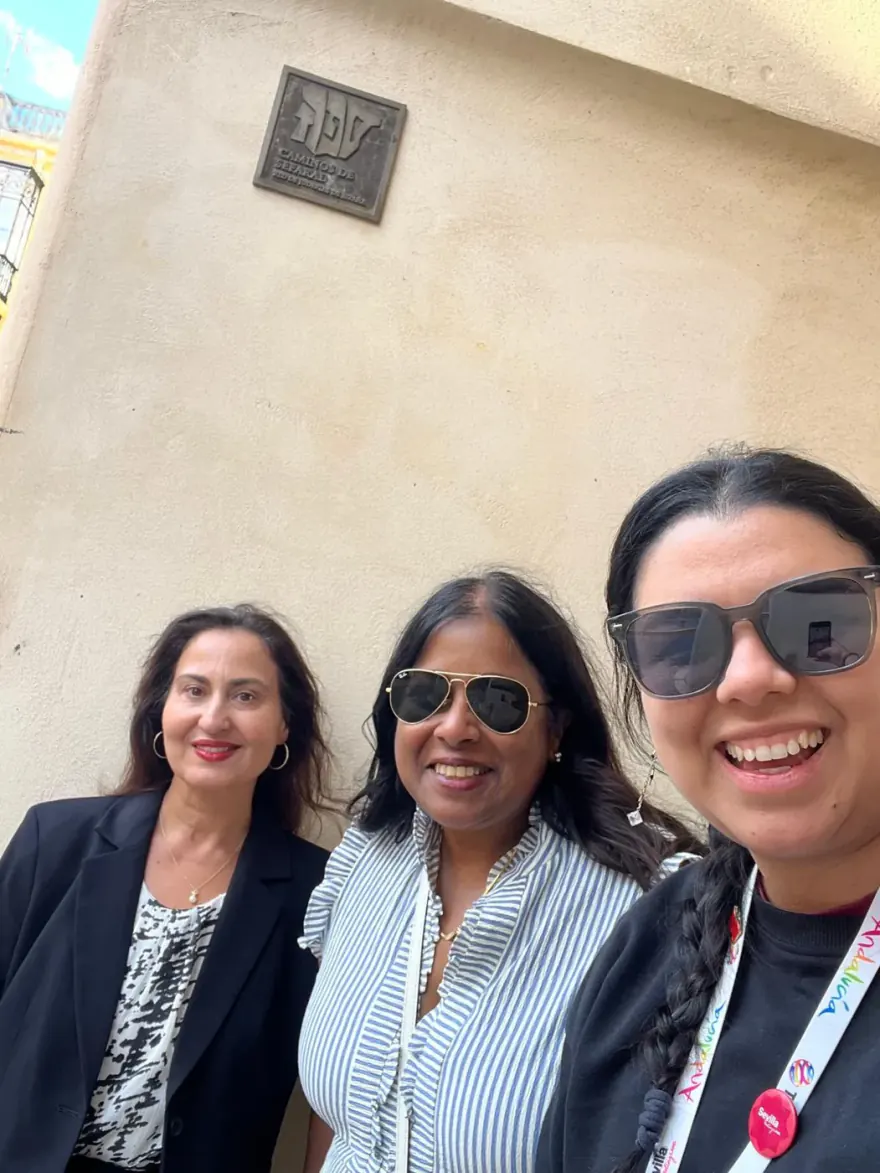
- The plaques of the Red de Juderías de España – Caminos de Sefarad.
- The sign of the Casa de Mose Bahari, remembering a Jewish resident of Seville.
- The medieval mikveh, under a brick vault: it lies beneath a building in use and is not always open to visit on your own.
- The skull tile on Calle Susona: a seventeenth-century legend, not a fifteenth-century fact.
What the archive says about Susona is in the legend of Susona.
How long does it take to walk the Jewish quarter?
Our guided route covers these six stops in two hours, and along the way many more places are seen and told. On your own, the time depends on your pace and on how long you stop at each place; the streets of the quarter are open and are walked on foot.
Is there a map of Seville's Jewish quarter?
Yes, two. On the street, the bronze map set into the pavement. And on this site, the map of the Jewish quarter, with the walled enclosure, the three synagogues of the aljama and the Jewish cemetery outside the wall: keep it open on your phone as you walk.
What do you miss without a guide?
Almost nothing in the Jewish quarter announces itself. The stretch of wall looks like any other wall, the cemetery is a garden and the main synagogue is a square. What turns the walk into history lies in the archives, not on the walls: notarial deeds such as that of Doña Leal, an eye doctor in 1474, lawsuits and royal warrants. And far more legend than document circulates in the quarter: telling one from the other is exactly a good guide's job.
Frequently asked questions
Can you walk around Seville's Jewish quarter for free?
Yes. Its streets are public and can be walked at any time. What has its own conditions are the buildings: Santa María la Blanca is a church in use, and the medieval mikveh lies beneath a building and is not always open to visit on your own.
Can you go inside a former synagogue in Seville?
Yes: Santa María la Blanca, the only one of the three former synagogues with visible remains, is a church today. One version of our guided route includes a visit inside, departing at 11:30 and 17:30 from Plaza Virgen de los Reyes.
Where was Seville's main synagogue?
It no longer exists: it stood on today's Plaza de Santa Cruz. After 1391 it became the church of Santa Cruz, which disappeared in the nineteenth century.
Is the skull on Calle Susona real history?
The tiled skull is a seventeenth-century legend, not a fifteenth-century fact. The contemporary chronicler names the father and mentions no daughter.
Sources
- Delgado Ramírez, A. A. (2024). Casa Sefardí de Sevilla. Trabajo Fin de Máster, Universidad Pablo de Olavide, curso 2023/2024.
- Montes Romero-Camacho, I. (1987). «Notas para el estudio de la judería sevillana en la Baja Edad Media (1248-1391)». En la España Medieval, 10, pp. 343-366.
- García Rodríguez, T. (2021). «La Puerta de la Carne y la memoria sefardí». Diario de Sevilla, 25 de septiembre de 2021.
- Red de Juderías de España – Caminos de Sefarad (web oficial).