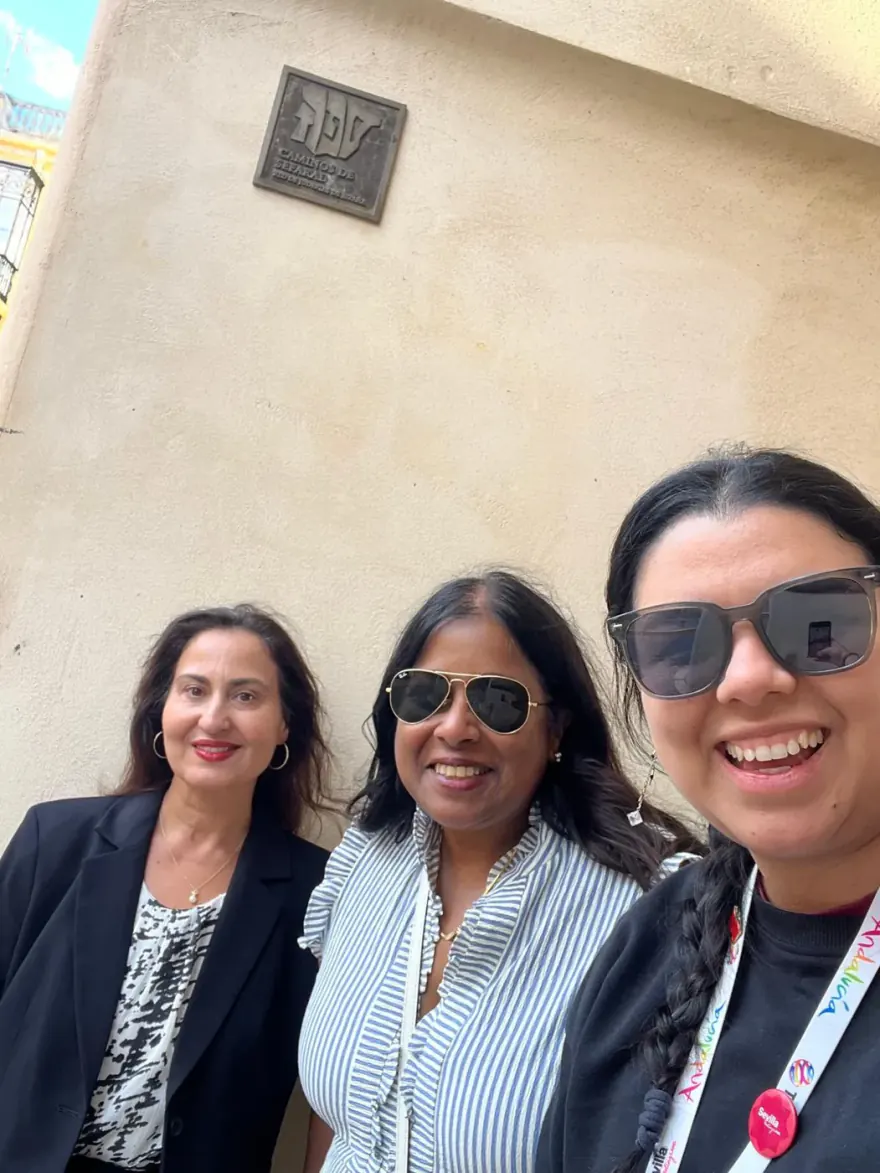
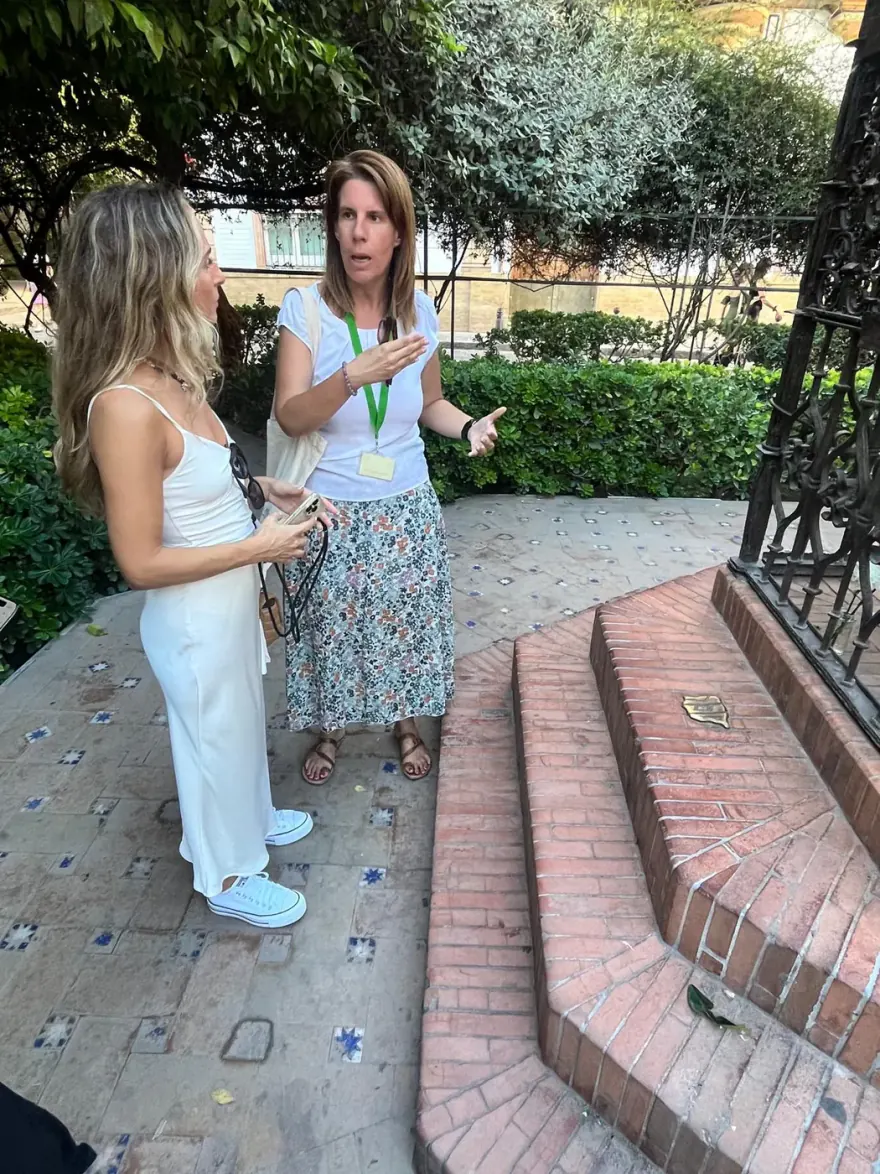
The dead, outside the walls
Anyone crossing the Murillo Gardens today is walking over a cemetery. Nothing announces it: no plaque, no change of level, no name. Orange trees, tiled benches, neighbours out for a walk or for exercise, groups of visitors on their way to the Plaza de Santa Cruz. Beneath that ground, however, lies the necropolis of the Jewish quarter of Seville. This is not a topographical accident but a consequence of religious law and urban custom. The medieval city lived with its dead far more closely than ours does, though not all in the same way: Christians buried within the walled city, in their churches; Muslims, as a rule, outside, although in Seville there are intramural burials as well; Jews, always outside. The cemetery had to remain apart from inhabited space, and so the community of Seville carried its own beyond the wall, right at the edge of the quarter — today's Santa Cruz and San Bartolomé districts — onto the land the gardens now occupy.
What appeared beneath Cano y Cueto street
The existence of that cemetery was not deduced from books but from a building site. During the works for the underground car park on Calle Cano y Cueto the city's Jewish cemetery was located, and the excavations brought to light burials whose subsequent treatment prompted protests from the Jewish community. The area now regarded as the Jewish necropolis is not confined to that plot: it extends from Calle Cano y Cueto to the district of San Bernardo, though its exact perimeter remains unknown. The gardens the city strolls through today sit, for the most part, over one section of the necropolis. What has been excavated is a fraction: the rest continues beneath the garden, at the gate of the old Jewish quarter, a step from the Plaza de los Refinadores and from the former synagogue of the Plaza de Santa Cruz.
It coincides exactly with the cemetery: the cemetery goes on beneath the Murillo Gardens, everything that has not been excavated. People assume that what has been dug is all there is, or all there was, but there are many dead buried down there.
The House of the Dream: returning the bones to the earth
Amores does not speak of this place as an observer. In 2012, together with the Israeli archaeologist and museum curator Renée Sivan, he submitted to the City Council a project for this very place: La Casa del Sueño, the House of the Dream. He deliberately refused to call it an interpretation centre. It had three strands: to welcome the Jewish community as neighbours of the Santa Cruz district; to give new burial to the human remains exhumed in the cemetery excavations; and to bring the Sephardic songs into the garden — some three hundred and fifty ladino lullabies gathered by a radio station for Sephardim in Israel and by several research groups — so that the walk itself became an immersion in sound. Hence the name, deliberately polysemic: Martin Luther King's «I have a dream», the dream of peace among peoples, and the sleep of children, deepest because purest. The project was never carried out. The following year, Seville left the Red de Juderías de España and its cultural route, Caminos de Sefarad.
A tombstone in the rain, a map on the wall
Very little of that funerary world remains visible. The most eloquent piece is the tombstone of Salomón ben Abraham, a block of white marble, now broken, dated 1345. Its epitaph, translated by Francisco Cantera Burgos, says that here was buried «a museum of every precious object concerning the Law and the Testimony», that «in the science of the stars he spoke wonders», and that «with him was hidden a book of medicine»: a physician, astronomer and exegete, R. Selomó son of R. Abraham ben Ya'is, gathered to his people in the month of Siwan of the year five thousand one hundred and five of the Creation. The stone — Roman, reused in the Middle Ages, recovered from works at the Cathedral — belongs to the Archaeological Museum of Seville and is on indefinite loan to the Sephardic Museum of Toledo, where it stands in an open courtyard. Amores puts it plainly: the piece is out in the open, with the rain falling on it. The Casa Sefardí project takes up both threads. In Room II, Life in the Jewish Quarter, one section is given over to the cemetery: a map drawn for the occasion showing the limits of the quarter, the area where the burials appeared and the line of the old city wall, together with two photographs of the graves provided by Amores. In Room III, a reproduction of the tombstone of Salomón ben Abraham with its full translation. «Seville, the city that expels part of its citizens, hands a house over to the people it expelled» — that, said Amores, was the ethical sense of his own project.
Sources
- Delgado Ramírez, A. A. (2024). Casa Sefardí de Sevilla. Trabajo Fin de Máster, Universidad Pablo de Olavide, curso 2023/2024.
- Amores, F. (arqueólogo, Universidad de Sevilla). Entrevista con la autora, 12 de abril de 2024 (comunicación personal).
- García Rodríguez, T. (2021). «La Puerta de la Carne y la memoria sefardí». Diario de Sevilla, 25 de septiembre de 2021.
- Epitafio de Salomón ben Abraham (1345), traducción de Francisco Cantera Burgos. Museo Arqueológico de Sevilla, en depósito en el Museo Sefardí de Toledo.