This guide is not a ranking. It gathers five places in the quarter that each have a concrete reason to be in it, with the same details for each, and five dishes with what the sources say, and do not say, about their link to Sefarad. None of these places appears on the FCJE's list of kosher establishments; if you keep kashrut, read our practical guide to kosher food, Shabbat and synagogue in Seville first.
Where can you eat in Seville's Jewish quarter?
On almost any street: the old Jewish quarter is full of bars and terraces. These five also have a story to tell. The details come from their own websites and from the press cited in the sources, checked on 16 November 2026; we give no opening hours or prices, which change, so confirm them before you go:
- Casa Mikva. Where: Calle Santa María la Blanca, opposite the church of the same name. What to order: the restaurant says it draws on Andalusian, Sephardic and Arab cooking; in February 2026 the local press picked out from its menu the Sephardic flower salad with chickpeas, shakshuka and spinach with chickpeas. Why here: according to the restaurant itself, its basement held Arab baths that were later turned into a mikveh, the Jewish ritual bath. In a Canal Sur report from February 2026, the professor of Prehistory and Archaeology Fernando Amores explains that the three vaults found during the renovation belong to an Arab bath that was also a Jewish one; we have found no published archaeological study.
- San Marco Santa Cruz. Where: Calle Mesón del Moro, 6. What to order: Italian and Mediterranean cooking; its website highlights the tagliatelle with lobster and the burrata with tomato and basil. Why here: the restaurant, opened in 1991, says it occupies 12th-century Arab baths, with star-shaped skylights in the vaults, which later became an inn, hence the street's name (the Moor's Inn), and then stables. That is the restaurant's own account; we have found no archaeological study that confirms it.
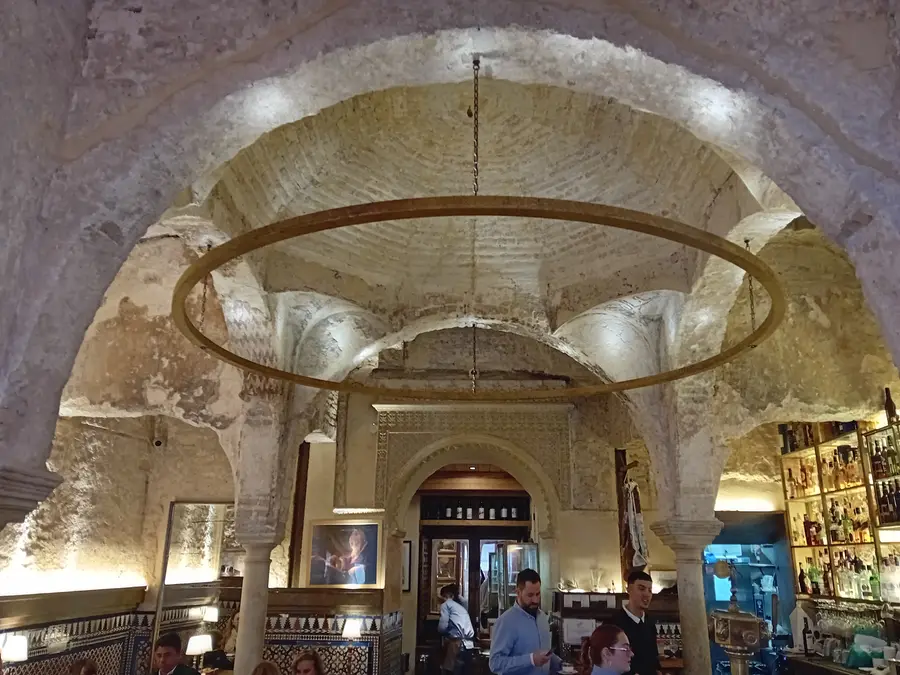
- Cervecería Giralda. Where: Calle Mateos Gago, 1, beside the Giralda, on the way into the Santa Cruz neighbourhood. What to order: tapas; according to its website, the menu brings back the best-known dishes of the old bar and adds new tapas from its kitchen. Why here: the bar occupies a 12th-century Almohad Islamic bathhouse that came to light in 2020. Álvaro Jiménez, the archaeologist who led the work, told El País it is “the only Islamic bath that has come down to us with its decoration complete”, painted in red ochre. It is older than the Jewish quarter, which took shape after the conquest of 1248.
- Casa Román. Where: Plaza de los Venerables, 1. What to order: according to its menu, acorn-fed Iberian ham, spinach with chickpeas and marinated fried dogfish (cazón en adobo). Why here: according to the house's own history, the premises opened in 1868 as a shop and tavern, and in 1934 Román Castro Medina founded his own business there, a grocery with a tavern in the back room; today his son runs it.
- Las Teresas. Where: Calle Santa Teresa, 2. What to order: according to its menu, Iberian cured meats, fried dishes such as shrimp fritters (tortillitas de camarones) or marinated dogfish, and stews such as spinach with chickpeas. Why here: it is a café-bar with a counter about a hundred metres from the Plaza de Santa Cruz, the last stop of the private tour, so it is the closest option when you finish.
Opposite Santa María la Blanca, just like Casa Mikva, stood the Arab baths from Moorish times that Alfonso X granted to the rabbi Yuçaf Cabaçay; no published source yet says that the ones in Casa Mikva's basement are those. What to see inside the church is in Santa María la Blanca, Seville's former synagogue; what truly remains of the Jewish quarter, in Barrio de Santa Cruz: what actually remains of the Jewish quarter.
How do tapas work in Seville?
From bar to bar. Visita Sevilla, the city's official tourism website, defines a tapa as a small portion of food, at a reduced price, meant to go with a drink, and tapear as a very Sevillian custom of moving from bar to bar; at the counter, standing shoulder to shoulder, orders are called out.
According to spain.info, Spain's official tourism portal, restaurants usually serve lunch between 13:00 and 16:00 and dinner between 20:00 and 23:30, and between 12:00 and 14:00 it is very typical to have a drink with some tapas. These are general times for the whole country: each place keeps its own, so check them on its website.
If you take the private Jewish Quarter tour in Seville, it fits that rhythm: it lasts two hours and leaves every hour from 10:00 to 17:00, Monday to Saturday. The 11:00 tour ends at aperitivo time, and the last stop is the Plaza de Santa Cruz, about a hundred metres from Las Teresas.
Which Seville dishes have Sephardic roots?
Fewer than people usually say. The cooking of Seville's Jews shared ingredients with that of their Muslim and Christian neighbours; what set it apart was above all the rules: no pork and no cooking on the Sabbath. That is why the sources speak more of customs than of recipes. This is what there is, with the same outline for each dish:
- Adafina and cocido. What it is: the Sabbath stew of the Jews of the peninsula, with legumes such as chickpeas or broad beans, vegetables and, if the purse allowed, some meat, left on the fire from before sundown on Friday, covered in embers, until the Saturday meal; the eggs cooked in it are the huevos haminados. What is documented: according to the historian Ana M. Gómez-Bravo, the name comes from the Andalusi Arabic addafína, “hidden” or “buried”, and adafina belongs to the same family as Spain's ollas, cocidos and pucheros. What is not proven: that cocido comes from adafina, or that conversos added salt pork to look Christian; it is often repeated, but we have found no document that proves it.
- Aubergines. What it is: a vegetable that reached the peninsula with the Muslims, according to Gómez-Bravo, and is eaten today fried, roasted or stuffed. What is documented: according to Gómez-Bravo, the aubergine was seen as the quintessential Jewish food, although everyone ate it, and 15th-century cancionero poems mock conversos with it; in addition, a 13th-century Andalusi cookbook, the Kitāb al-ṭabīj, marks at least six of its recipes as Jewish, among them stuffed aubergines. What is not proven: that the fried aubergines with honey served in Andalusia today come from Jewish cooking.
- Almodrote. What it is: a paste of pounded cured cheese and garlic; with aubergine, it becomes the almodrote de berenjena of Sephardic cooking. What is documented: Gómez-Bravo traces its recipes from the Llibre de Sent Soví, a 14th-century Catalan cookbook, to Juan Vallés's Regalo de la vida humana, from the 16th, which makes it with aubergine; today it is a staple of the Sephardim of the diaspora. What is not proven: that it was born as a Jewish dish; Gómez-Bravo does not attribute it to any community.
- Buñuelos. What it is: fried dough, served with honey or sugar. What is documented: in the Ladino Bible printed in Constantinople in 1547, manna tastes like “bunuelo kon miel”, a fritter with honey, and bimuelos are still a Sephardic Hanukkah sweet. What is not proven: that pestiños or other Andalusian fried sweets come from Jewish cooking; we have found no historical source that says so.
- Spinach with chickpeas. What it is: spinach stewed with chickpeas, a tapa found today on the menus of Casa Román, Las Teresas and Casa Mikva. What is documented: nothing about its origin. What is not proven: the Andalusi or Sephardic origin often attributed to it in guides and menus, without citing any historical source.
Bimuelos and the rest of the Hanukkah table are in Hanukkah 2026: dates and meaning.
What did Seville's conversos eat, according to Bernáldez?
Andrés Bernáldez, parish priest of Los Palacios and chaplain to the archbishop of Seville, told it with hostility in his chronicle of the Catholic Monarchs. In the chapter on the beginning of the Inquisition he writes that the conversos never gave up eating “in the Jewish manner”: little stews and pots, onions and garlic fried in oil, and meat they stewed with oil instead of lard, so as not to eat pork.
It is a text written to accuse: it even says their houses stank of those stews. But it shows what was being watched in Seville's kitchens in the years when the Inquisition began to act in the city, from 1480. Read today, it sounds like ordinary Andalusian cooking, and that does not prove that Seville's sofrito comes from Jewish cooking: only that cooking with oil could mark you out. The story of that tribunal is in the Castle of San Jorge and the Spanish Inquisition in Seville.
Frequently asked questions
What time do people eat in Seville?
In Seville, lunch is between 13:00 and 16:00 and dinner between 20:00 and 23:30: those are the hours when restaurants in Spain usually serve, according to spain.info, the country's official tourism portal, and between 12:00 and 14:00 it is very typical to have a drink with some tapas. Every bar and restaurant in Seville keeps its own hours, so confirm them before you go.
What is adafina?
Adafina is the Sabbath stew of the Jews of the Iberian Peninsula: a pot of legumes such as chickpeas or broad beans, vegetables, sometimes meat and eggs, left on the fire from before sundown on Friday, covered in embers, so it could be eaten on Saturday without cooking. The name comes from the Andalusi Arabic addafína, “hidden” or “buried”. Among Sephardic Jews it is also called hamín.
Does cocido come from adafina?
It is not proven. The historian Ana M. Gómez-Bravo places adafina in the same family as Spain's ollas, cocidos and pucheros, but kinship is not descent. The story that conversos added salt pork to cocido to look Christian is often repeated, and we have found no document that proves it; the chronicler Andrés Bernáldez says rather the opposite: that they cooked with oil so as not to eat pork.
Is spinach with chickpeas a Sephardic dish?
There is no evidence for it. Spinach with chickpeas is a common tapa in Seville's Jewish quarter today, on the menus of Casa Román, Las Teresas or Casa Mikva, and it is often given an Andalusi or Sephardic origin, but we have found no historical source that documents it. Of the Jewish cooking of Seville, what is documented is the Sabbath adafina and the aubergine's reputation as Jewish food.
Sources
- Canal Sur Media (27 February 2026). “Un antiguo baño judío, convertido en un restaurante en Sevilla” (an old Jewish bath turned into a restaurant in Seville). Canal Sur: Casa Mikva, opposite Santa María la Blanca, and the vaults found during its renovation, with the archaeologist Fernando Amores
- Casa Mikva — official website: address, style of cooking and history of its basement (consulted on 16 November 2026)
- Ibáñez, C. (12 February 2026). “Casa Mikva, el restaurante donde las papas aliñás se comen con las manos” (Casa Mikva, the restaurant where you eat dressed potatoes with your hands). CosasDeCome Sevilla: dishes on the menu and chefs
- San Marco Santa Cruz — official website: address, menu and the history of the building as the restaurant tells it (consulted on 16 November 2026)
- Cervecería Giralda — official website: address, tapas menu and the recovery of the 12th-century hammam (consulted on 16 November 2026)
- Molina, M. (16 February 2021). “El baño islámico del siglo XII oculto tras la barra del bar” (the 12th-century Islamic bath hidden behind the bar counter). El País, reproduced by Arquitectura Viva: the Almohad hammam of the Cervecería Giralda and the archaeologist Álvaro Jiménez
- Casa Román — “Historia” (history): the shop and tavern of 1868 and Román Castro Medina's founding in 1934 (consulted on 16 November 2026)
- Casa Román — “Carta” (menu): the house dishes (consulted on 16 November 2026)
- Café Bar Las Teresas — official website: address and menu (consulted on 16 November 2026)
- Visita Sevilla, Seville's official tourism website — “Discover Seville through its tapas”: what a tapa is and how tapear works
- spain.info, Spain's official tourism portal — opening times and public holidays: usual meal and aperitivo times (consulted on 16 November 2026)
- Gómez-Bravo, A. M. (2014). “Adafina: The Story Behind the Recipe”. The Converso Cookbook, Stroum Center for Jewish Studies, University of Washington: what adafina was, its name and huevos haminados
- Gómez-Bravo, A. M. (2014). “Almodrote: The Story Behind the Recipe”. The Converso Cookbook, University of Washington: aubergine as “Jewish food”, the cancionero poems and the almodrote recipes
- Pérez Alonso, M.ª I. (2015). “La olla judía del šabbat: estudio lexicológico y lexicográfico de adafina, ḥamin, caliente(s) y otras denominaciones” (the Jewish Sabbath pot: the words adafina, hamin and others). Espacio, Tiempo y Forma, Series III, Medieval History, 28, 441–458.
- Bernáldez, A. Historia de los Reyes Católicos D. Fernando y Doña Isabel (history of the Catholic Monarchs), vol. I, ch. XLIII, on the beginning of the Inquisition. Seville: Sociedad de Bibliófilos Andaluces, 1870 (Internet Archive).
- Drummond, J. (27 May 2025). “Iberian Stuffed Eggplants”. Biblical Archaeology Society, BAR Test Kitchen: the 13th-century Kitāb al-ṭabīj and its recipes marked as Jewish
- Alhadeff, T. (25 December 2016). “Manna from heaven: Bumuelos, a Sephardic Hanukkah treat”. Stroum Center for Jewish Studies, University of Washington: the “bunuelo kon miel” of the 1547 Ladino Bible
- Cover photo: Pedro Szekely, “Sevilla, Spain”, Calle Santa María la Blanca, 2018. CC BY-SA 2.0, via Wikimedia Commons.
- Photo of the Cervecería Giralda hammam: CarlosVdeHabsburgo, “Baños árabes, Calle Mateos Gago, Sevilla 01”, 2023. CC BY-SA 4.0, via Wikimedia Commons.