It runs off the plaza de Doña Elvira, in the heart of the Barrio de Santa Cruz, and it is so narrow that two people pass sideways. On the wall there are two tiles: a skull and a name, Susona. For centuries the street was called calle de la Muerte, the street of death. The story that explains that name is one of the best Seville has, and it is told on almost every guided walk in the city. It is also, almost in its entirety, a legend. It is worth seeing exactly where the archive ends and the tale begins — because the archive has a story of its own, and it is no worse.
What is actually documented
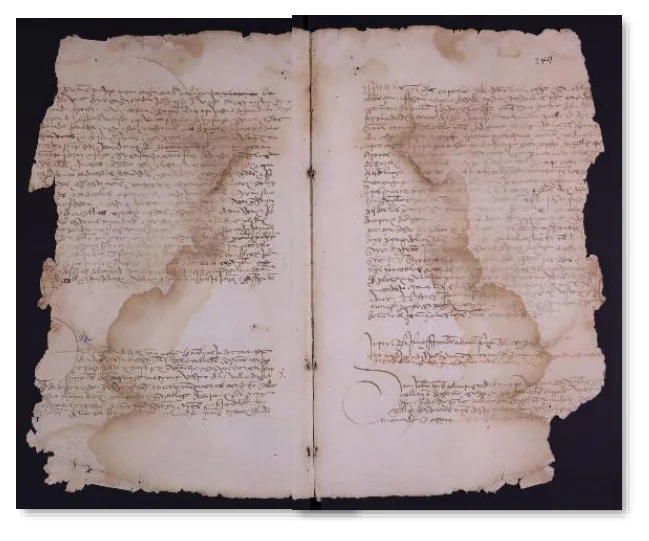
The father existed. Diego de Susán was one of the richest and most powerful conversos in Seville: a resident of the parish of San Isidoro and a veinticuatro — an alderman — of the city, an office held by only twenty-four men. On 14 April 1478 the Catholic Monarchs confirmed him in that office. Less than three years later, the tribunal those same monarchs had just installed in Seville burned him. Andrés Bernáldez, parish priest of Los Palacios and a chronicler contemporary with the events, tells what happened in the city when the Inquisition was established, and names the first to be burned.
And a few days later they burned three of the chief men of the city and of the richest, who were Diego de Susán, whose worth they said was ten cuentos, and he was a great rabbi […] and neither favours nor riches ever availed them.
Burned with him were Manuel Sauli and Bartolomé de Torralba. Arrested were Pedro Fernández Benadeva, steward of the cathedral chapter, who according to Bernáldez kept in his house arms enough for a hundred men, and Juan Fernández Albolasia, “magistrate of justice and a great jurist”. We do not know the exact date of the auto-da-fé at which Susán died: it is dated either 6 February or 1 March 1481. Once he was dead the Susán family of Seville fled to the lands of the nobility. All of that is people with names, with offices and with paperwork.
The daughter arrives two hundred years late
Bernáldez names the father and mentions no daughter. He does not mention the conspiracy either: the chroniclers of the time pass over the alleged plot in silence, which is striking for an event of that magnitude. The courtship motif appears for the first time, as far as we know, in the “Anales eclesiásticos y seculares” of Diego Ortiz de Zúñiga, Seville's great annalist, printed in 1677 — almost two centuries later. And even there it is not yet our story: Ortiz de Zúñiga speaks of a gathering of six conversos who blasphemed on Maundy Thursday 1478 and were discovered by a knight of the Guzmán family, “by means of a courtship”. The wooing is there; the name Susona is not.
The rest was fixed in the nineteenth century. José Amador de los Ríos, the great nineteenth-century historian of the Jews of Spain, took up the Seville Relación with the names and aims of the conspiracy; and at the end of the century Father Fidel Fita published the Seville sources kept in the Biblioteca Colombina of the cathedral. The historian Isabel Montes Romero-Camacho, who has gone back over that whole chain, sums it up without hedging.
As things stand today, we have no direct documentary sources referring to the famous converso conspiracy against the establishment of the Inquisition in Seville.
She was not even called Susona
In the sources, Diego de Susán's daughter is called Sara. “Susona” comes from her father's surname, and the surname, according to Antonio Cascales, comes from the Abenxuxén or Shoshén family of Toledo: the woman who gives the street its name is called, quite literally, “the Susán one”. She was probably not an only daughter either: another is recorded, María Pinta, married to Álvaro Suárez, son of Pedro Fernández Benadeva — which means the two families of the accused were joined by marriage before the Holy Office ever arrived.
And there is another possible informer
If anyone informed, the archive offers another candidate. Among the conspirators named in the Relación there is a Medina whom Cascales identifies as the alderman Luis de Medina, treasurer of the Mint. After a silence, Luis de Medina reappears in the notarial record with a very particular office: treasurer and receiver of the goods confiscated from those condemned as heretics. Cascales suggested that this rehabilitation may have been the payment for having denounced the others — which, in his words, “would clear Susona of all blame”. Juan Gil warns that there are so many Medinas that identifying him with certainty is difficult. And Benzion Netanyahu went further: the papers of the Holy Office, above all the anonymous ones and those issuing from the Inquisition itself or its supporters, must be read with suspicion. The title of the most recent study of the affair is, literally, a question.
The skull and the tiles
The ending of the legend is the one that left its mark on the street: repentant, Susona is said to have asked in her will that her head be cut off and hung above the door of her house, as a warning. The skull is said to have stayed there, behind a grille, until it was replaced by a tile. As to when, the popular accounts do not agree: some give 1845; others say the house was restored in 1931 and that its owners commissioned the tile from the ceramicist Ramos Rejano. We have not been able to confirm either date in a primary source, and we say so rather than pick whichever reads better. It is the same rule this whole project follows: nothing on the wall without a document behind it.
Why it matters who informed
Because the legend does something to the facts. It turns the arrival of the Inquisition in Seville — a tribunal that began by burning the richest men in the city — into a love story with a woman to blame. What is documented has no romance in it: it has men with names and offices, arms kept in a house, a fire, and a date we cannot even fix. And the figure of the beautiful Jewess who betrays her own for a Christian is a literary type found all over Europe: when a character fits a pre-existing mould that well, it is wiser to distrust the character than the mould.
The street is still there, and so is the quarter. If you want the full context of that century, the chronology is in the Jewish quarter of Seville; the room Inquisition and diaspora gathers the documents of those years, from the edict of expulsion to the 1834 decree that abolished the tribunal. And if this story interests you because of the women who turn up in the paperwork rather than in the legends, Doña Leal was healing eyes in 1474 and her contract survives. The year that set it all in motion is told in 1391.
Sources
- Montes Romero-Camacho, I. (2010). «Sevilla 1480: ¿una conjura conversa contra la Inquisición?». En Homenaje al profesor Eloy Benito Ruano, vol. II. Murcia, pp. 521-536.
- Bernáldez, A. Memorias del reinado de los Reyes Católicos (citado por Montes Romero-Camacho, 2010, p. 524).
- Ortiz de Zúñiga, D. (1677). Anales eclesiásticos y seculares de la muy noble y muy leal ciudad de Sevilla.