This guide is for anyone who wants to step inside Santa María la Blanca knowing what they are looking at. The history of the quarter's three synagogues, and of how they ended up as churches, is in the three synagogues of Seville, from mosques to churches; the story of the attack that changed everything, in 1391: the year that changed Seville's Jewish quarter. Here is the practical side: what to see, the hours the parish publishes, how to walk there and how to behave in a working church.
What is Santa María la Blanca?
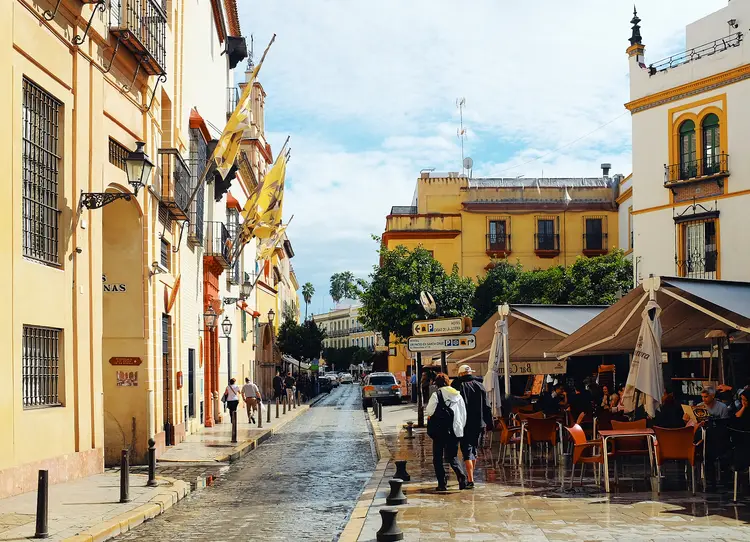
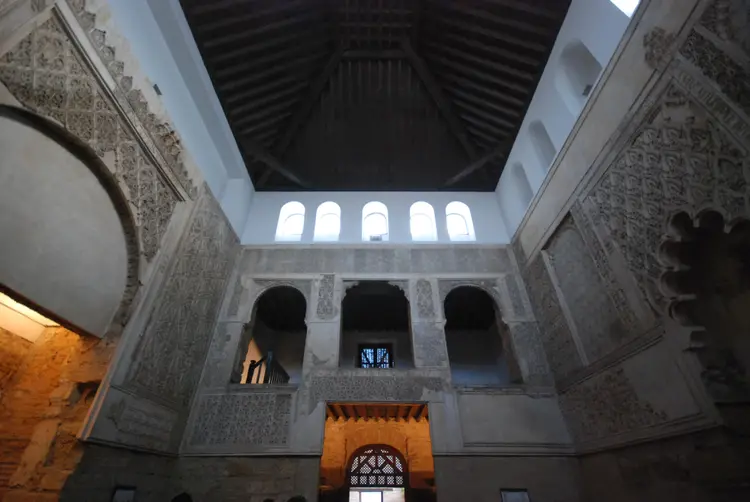
A Catholic church in use, on the street that bears its name, in the Jewish quarter, between the Santa Cruz and San Bartolomé neighbourhoods. According to its parish, it was a mosque between the 11th and 13th centuries; after the conquest of 1248 it passed to the Jewish community, which enlarged it and turned it to face east–west, and it was a synagogue for a little over a century, until the attack of 6 June 1391. Afterwards, the cathedral chapter adapted it for Christian worship.
It is the only one of Seville's three synagogues that keeps remains, though not in plain sight: the Baroque remodelling, finished in 1665, covered them. The rebuilding began in 1662 under the supervision of the canon Justino de Neve, and the reopening was celebrated with temporary altars in the square beside the church, decorated with paintings by Murillo, according to the Prado Museum.
What is there to see in Santa María la Blanca?
Outside and inside, these are the things worth your time, with the same details for each:
- The Gothic doorway. Where: on the façade on Calle Santa María la Blanca. Why it matters: according to the parish, it was built in the 15th century, with archivolts and studs, and it is one of the few parts of the exterior older than the Baroque remodelling. Tip: on the entrance arch you can read “Sin pecado original desde el primer instante de su ser” (without original sin from the first instant of her being), the opening words of Alexander VII's bull of 1661, which lies at the origin of the remodelling.
- The bell gable. Where: above the main façade. Why it matters: it rises from the remains of an earlier tower-façade; its two upper sections are the work of the architect Sánchez Falconete, around 1650. Tip: look at it from across the street: that is where the Arab baths stood, from Moorish times, which Alfonso X granted to the rabbi Yuçaf Cabaçay.
- The columns. Where: between the three naves. Why it matters: there are ten, of red marble from Antequera, and in the remodelling they replaced the synagogue's pillars, while the horseshoe arches were rebuilt as round arches. Tip: the floor plan you walk through is, in essence, the space of the synagogue.
- The plasterwork. Where: on the vaults, the dome and the undersides of the arches. Why it matters: the white and gold of the remodelling, probably by the Borja brothers and Pedro Roldán according to the parish, sets this church apart from every other in Seville. Tip: look among the ornaments for a small replica of the Giralda.
- Murillo's Last Supper. Where: inside the church. Why it matters: Murillo painted it in 1650 for the parish's Sacramental Brotherhood, and it is the only one of his five canvases for Santa María la Blanca still in the church. Tip: it is his most tenebrist work, lit as if by candlelight; give your eyes a moment to adjust.
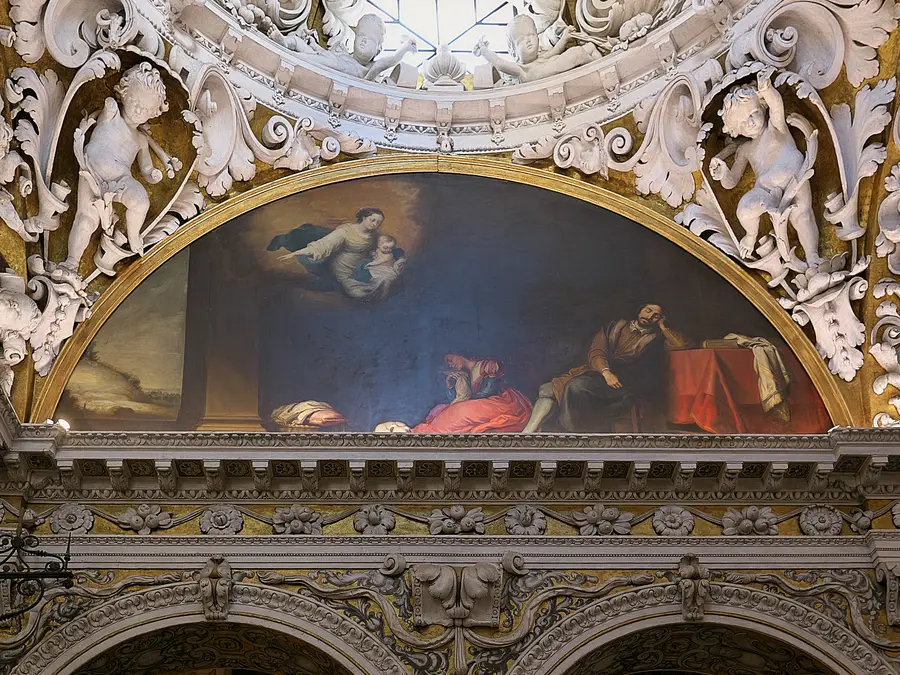
- The lunette under the dome. Where: beneath the dome, in front of the presbytery. Why it matters: Murillo's two large lunettes on the origin of the church's dedication hung there; today you see a copy of The Patrician's Dream, because the original is in the Prado Museum. Tip: look up on both sides of the dome.
- What remains of the synagogue. Where: hidden behind the plasterwork and the high altarpiece. Why it matters: the parish lists the outer walls, a row of narrow slit windows on the upper level and the shelves where the Torah scrolls were kept; in 2024, while the high altarpiece was being restored, the wall of the heichal, the Torah ark, with three niches, was briefly exposed. Tip: you will not see it; what you do see is the scale of the building.
Where are Murillo's paintings for Santa María la Blanca today?
Only one is still in the church. Murillo painted five large canvases for Santa María la Blanca: the Last Supper, in 1650, and four lunettes for the remodelling, a commission that, according to the Prado, his friend Justino de Neve secured for him. During the French occupation, Marshal Soult took all four to France, probably around 1810. The Last Supper was requisitioned too, but it returned to the parish in 1813, according to the Andalusian Institute of Historical Heritage.
- The Patrician's Dream. What it shows: the patrician John and his wife see the Virgin in a dream, asking them to build a church, the origin of Santa Maria Maggiore in Rome. Where it is today: in the Prado Museum, Madrid, since 1901; from 1816 to 1901 it was in the Royal Academy of Fine Arts of San Fernando.
- The Patrician Reveals his Dream to Pope Liberius. What it shows: the next part of the same story, which gives the church its dedication, Our Lady of the Snows. Where it is today: in the Prado Museum, alongside its companion.
- The Immaculate Conception. What it shows: the Virgin of the Immaculate Conception, the devotion Seville celebrated after the papal bull of 1661, for one of the side aisles. Where it is today: in the Louvre Museum, Paris.
- Faith, or The Church Triumphant. What it shows: the exaltation of the Eucharist, the companion of the Immaculate Conception in the other side aisle. Where it is today: at Buscot Park, in the United Kingdom, in the Faringdon Collection.
- The Last Supper. What it shows: Jesus blesses the bread among the apostles, in a candlelit scene. Where it is today: in Santa María la Blanca, for which it was painted in 1650.
What are the opening hours of Santa María la Blanca?
The hours are those the parish publishes on the official Santa María la Blanca website, consulted on 16 November 2026; the parish itself warns that they can change for pastoral needs or conservation work, so check them before you go. With the same details for each case:
- Cultural visits. What the parish publishes: Monday to Thursday, 11:30 to 13:00 and 17:00 to 18:45. Note: in July and August cultural visits are suspended for conservation and restoration work.
- Saturdays and Sundays. What the parish publishes: they are reserved exclusively for worship and pastoral care. Note: there are no cultural visits at weekends.
- Masses. What the parish publishes: Monday to Saturday at 11:00 and 20:00; on Sundays at 11:00, 13:00 and 20:00. Note: in July and August there is no 13:00 Mass on Sundays.
- Groups. What the parish publishes: the group leader must book a day and time in advance in the parish diary, and can ask for a visit guided by specialised staff lasting 20 or 40 minutes. Note: a donation is suggested according to the number of people, for the conservation of the church.
- Price. What the parish publishes: its website gives no entry price for individual visits. Note: the official tourism portal of the Junta de Andalucía gives a suggested donation of €2 and different hours, Monday to Thursday from 10:00 to 13:00 and 18:00 to 19:30; if in doubt, follow the parish's hours.
A note for 2027: on 29 July 2026, the parish announced that the Archdiocese of Seville will restore the outside of the façade, with works planned for early 2027 and no end date yet. If you travel then, expect scaffolding on the doorway.
How do you get to Santa María la Blanca?
On foot. It stands on Calle Santa María la Blanca, which with Calle San José forms an axis of the old Jewish quarter, between Santa Cruz and San Bartolomé. From the Plaza de Santa Cruz or the Murillo Gardens it is a few minutes' walk, and from the Plaza Virgen de los Reyes, at the foot of the Giralda, a short stroll.
On our self-guided walking route through Seville's Jewish quarter it is the fourth of six stops, between San Bartolomé and the Murillo Gardens; if you walk it from Monday to Thursday, you can go in during visiting hours.
What should you bear in mind when visiting a working church?
That Santa María la Blanca is not a museum but the church of a living parish, which keeps weekends for worship. Go in during the cultural visiting hours and not during a Mass; if you arrive during a service, wait or sit quietly. Dress respectfully, speak softly and ask before taking photos. The donation, according to the parish, goes to the upkeep and conservation of the church.
Can you visit Santa María la Blanca with a guide?
Yes, in two ways. The parish offers groups guided visits of 20 or 40 minutes, with the day and time booked in advance. And Santa María la Blanca is the fourth stop on our private Jewish Quarter tour in Seville: two hours just for your group, with official guides, in English or Spanish, for €176.40 in total for up to 7 people.
The hourly route, Monday to Saturday from 10:00 to 17:00 from the Mercury fountain, includes it as a stop. The visit inside comes with the version that leaves at 11:30 and 17:30 from the Plaza Virgen de los Reyes, for a small supplement shown on the tour page. Booking is online and in advance.
Frequently asked questions
How much does it cost to enter Santa María la Blanca?
The parish of Santa María la Blanca gives no entry price for individual visits on its website; for groups, it suggests a donation according to the number of people, which goes to the conservation of the church. The official tourism portal of the Junta de Andalucía gives a suggested donation of €2 (consulted on 16 November 2026). Confirm it with the parish before you go.
What are the Mass times at Santa María la Blanca?
According to the parish website, consulted on 16 November 2026, Santa María la Blanca has Mass from Monday to Saturday at 11:00 and 20:00, and on Sundays at 11:00, 13:00 and 20:00; in July and August there is no 13:00 Mass on Sundays. The parish warns that its times may change for pastoral reasons.
Can you see anything of the synagogue inside Santa María la Blanca?
Almost nothing to the naked eye. According to the parish, what remains of the synagogue of Santa María la Blanca is the outer walls, a row of narrow slit windows on the upper level and the shelves for the Torah scrolls, all hidden behind the Baroque plasterwork. In 2024, while the high altarpiece was being restored, the wall of the heichal was briefly exposed. What you can appreciate is the space, which essentially keeps that of the synagogue.
Is Santa María la Blanca in Seville the same as the one in Toledo?
No. The synagogue of Santa María la Blanca in Toledo is a different building, in a different city: a former Mudéjar synagogue with five naves, horseshoe arches and octagonal pillars, turned into a Christian church in 1411 according to the monument's website, and today a monument you visit. Santa María la Blanca in Seville is a Baroque church in use, with red marble columns, which was a synagogue until 1391.
Why is it called Santa María la Blanca?
Because its dedication is to Our Lady of the Snows, that of the Roman basilica of Santa Maria Maggiore, which tradition links to a miraculous snowfall in Rome on 5 August. “As white and pure as snow,” the parish sums it up. According to the Prado Museum, the title also happened to echo the surname of the canon Justino de Neve, who led the Baroque remodelling of Santa María la Blanca.
Sources
- Parish of Santa María la Blanca (Seville) — official website: Mass and cultural visiting times, group visits, history of the church and notice of works on the façade (consulted on 16 November 2026)
- Junta de Andalucía, andalucia.org — “Parroquia de Santa María la Blanca”: description of the church, suggested donation and 2026 opening hours (consulted on 16 November 2026)
- Visita Sevilla, Seville's official tourism website — “Santa María La Blanca”: history and architecture of the church
- Museo Nacional del Prado — “The Foundation of Santa Maria Maggiore in Rome. The Patrician's Dream” by Murillo (P000994): catalogue entry and provenance
- Museo Nacional del Prado — exhibition “Murillo and Justino de Neve. The Art of Friendship”: the remodelling of Santa María la Blanca and its canvases
- Buscot Park (Faringdon Collection) — “Faith or the Church Triumphant” by Murillo, catalogue no. 70: the set of four lunettes and where each one is
- Núñez Casares, L., Gutiérrez Montero, F., Martín García, L. and Fernández Ruiz, E. (2000). “Intervención de la pintura ‘La Cena’ de Bartolomé Esteban Murillo” (the conservation of Murillo's Last Supper). PH, bulletin of the Andalusian Institute of Historical Heritage, 32.
- Gómez López, D. (1 May 2024). “La sinagoga de Santa María la Blanca” (the synagogue of Santa María la Blanca). El Patio Colorao, Universidad Pablo de Olavide: the heichal wall found behind the high altarpiece
- Toledo Monumental — “Former Synagogue of Santa María la Blanca” (Toledo): architecture and conversion into a Christian church
- Delgado Ramírez, A. A. (2024). Casa Sefardí de Sevilla. Master's dissertation (Trabajo Fin de Máster), Universidad Pablo de Olavide, 2023/2024.
- Cover photo: CarlosVdeHabsburgo, “Retablo SM la Blanca”, Seville, 2014. CC BY-SA 4.0, via Wikimedia Commons.
- Photo of the copy of The Patrician's Dream: Jl FilpoC, “El sueño del patricio, Iglesia de Santa María la Blanca (Sevilla)”, 2020. CC BY-SA 4.0, via Wikimedia Commons.