For many travellers, the word “Sephardic” first comes up in Seville, in front of a Red de Juderías plaque or in a conversation about surnames. But the Sephardim are not just a memory: they are one of the great branches of the Jewish people, with their own rite, language and cooking, spread today across much of the world. This is their story, told from the city where the break began.
What does Sephardic mean?
Sephardic comes from Sepharad, the Hebrew name for the Iberian Peninsula. According to Encyclopaedia Britannica, the term covers the Jews who lived in Spain and Portugal from late Roman times until the persecutions and expulsions of the late fifteenth century, together with their descendants. In the peninsula their presence is securely documented from the first century BC, and by the second century AD their communities were already significant, as the Origins room of the virtual museum explains.
Over time the word widened. In everyday use, especially in Israel, Jews from North Africa and the Middle East who follow Sephardic traditions are also called Sephardim, even though not all of them descend from the peninsula. For the Jews of the Near and Middle East, the more precise name is Mizrahim, Hebrew for “easterners”.
How are Sephardic and Ashkenazi Jews different?
In custom, not in faith. Ashkenazi Jews descend from the Jews of the Rhineland and neighbouring France who later spread to Poland, Lithuania and Russia, which is why their synagogue ritual is called the “German rite”, as against the “Spanish rite” of the Sephardim. According to Britannica, the two differ in how they pronounce Hebrew, in liturgy and synagogue chanting, and in their home language: Yiddish, with a Germanic base, rather than Judeo-Spanish. They are two traditions, not two sects.
It shows at the table too. At Hanukkah, Ashkenazi homes are known for latkes, potato pancakes, while Sephardic tradition has buñuelos, called bimuelos in Judeo-Spanish (as we explain in our article on Hanukkah 2026). In Israel the two traditions live side by side, and the chief rabbinate has both a Sephardic and an Ashkenazi chief rabbi.
What happened in Seville in 1391 and 1492?
They were the two blows that turned the Jews of Sepharad into a diaspora. In 1391, the preaching of Ferrán Martínez unleashed the attack on Seville's Jewish quarter, which spread across the peninsula. According to Britannica, thousands of Jews were killed and tens of thousands were baptised to save themselves, more than a hundred thousand on a moderate estimate. Thus arose the large group of conversos, who bore the surnames of their Christian neighbours, as we explain in Sephardic surnames: what Seville's archives show.
The second blow was the edict of 31 March 1492, which gave three months to be baptised or leave the kingdoms. Around a hundred thousand people left Spain, most for Portugal and North Africa, and some fifty thousand sailed from the port of Seville (1492: the edict, the port of Seville and the birth of Ladino). In Portugal history repeated itself: in December 1496 Manuel I ordered the Jews to leave, and when they gathered in Lisbon to depart, most were baptised by force.
Those two blows produced the two great branches of the diaspora. Those who left as Jews in 1492 formed the Mediterranean one, in North Africa and the Ottoman Empire. Conversos and their descendants who, generations later, left Portugal and Spain to return openly to Judaism formed the branch of Amsterdam, Hamburg, London and the Americas: the so-called Portuguese Nation, or Western Sephardim.
Where did Sephardic Jews settle after Spain and Portugal?
These are six of their most important destinations, with the same details for each:
- Salonica, today Thessaloniki (Greece). When: from 1492, under the Ottoman Empire. Who: exiles from Sepharad who made the city one of the great Sephardic centres; by the sixteenth century more than half its inhabitants were Jewish. Trace today: between March and August 1943 the Germans deported more than 45,000 Jews from Salonica to Auschwitz; fewer than 2,000 remained after the war.
- Istanbul and Izmir (Turkey). When: from 1492, at the heart of the Ottoman Empire. Who: exiles who, with those of Salonica, formed the Eastern Sephardic diaspora, where Judeo-Spanish was spoken for centuries. Trace today: Turkey is, with Israel, one of the few countries where that language is still alive.
- Tetuán and Tangier (Morocco). When: from 1492; the first wave that left Seville went to North Africa. Who: exiles who settled alongside the local, Arabic-speaking Jewish communities. Trace today: Haketia, the Judeo-Spanish of northern Morocco, rich in Arabic and Hebrew words.
- Amsterdam (Netherlands). When: from the end of the sixteenth century, almost a hundred years after Portugal's forced baptisms. Who: Portuguese New Christians who in Amsterdam could return openly to Judaism. Trace today: the Esnoga, the Portuguese Synagogue inaugurated in 1675, is still in use and is lit by hundreds of candles.
- Hamburg and Altona (Germany). When: from the last third of the sixteenth century; in 1612 the city council signed a contract with the “Portuguese Nation”. Who: Portuguese New Christians, merchants and physicians among them. Trace today: the Königstraße cemetery in Altona, with some 2,000 Portuguese burials between 1611 and 1869.
- Recife and New York (the Americas). When: in 1654, when Portugal retook Dutch Brazil. Who: twenty-three Jewish refugees from Recife who reached New Amsterdam, the future New York. Trace today: the congregation they founded, Shearith Israel, known as the Spanish and Portuguese Synagogue, is the first Jewish congregation in North America.
The routes of that diaspora, with the names of people from Seville who took them, are in the Inquisition and diaspora room of the virtual museum.
Why were there Sephardic Jews in Hamburg?
Because in the last third of the sixteenth century Hamburg admitted Portuguese New Christians, who became the first Jews allowed to settle there permanently. In 1595 there were some seven Portuguese families; in 1609, 98 people are recorded. In February 1612 the city council signed a contract with the “Portuguese Nation”: residence, freedom of conscience and protection in exchange for obedience and payments, but always as foreigners.
They spoke Portuguese at home and in sermons, and kept Spanish, almost as a sacred language, for religious and literary texts. On 3 September 1652 their three congregations merged into a single community, Bet Israel. That community was dissolved in 1942, under Nazism, and more than eighty Portuguese Jews from Hamburg fell victim to the extermination.
Their most visible trace is in Altona, then outside Hamburg and today one of its districts. The city would not let them have a cemetery on its territory, so on 31 May 1611 three Portuguese merchants bought land there from Ernst III von Schauenburg, the local ruler. Until it closed in 1869, the Königstraße cemetery received some 2,000 Portuguese burials; many gravestones lie flat on the ground, like those in the cover photo.
What language did Sephardic Jews speak?
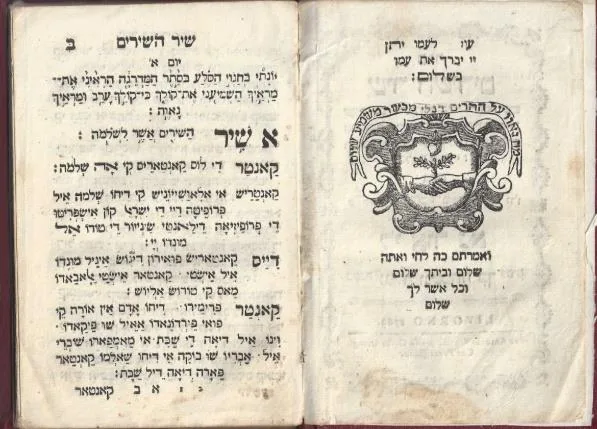
It depends on the branch. In the East it was Judeo-Spanish, also called Ladino or Judezmo: the medieval Castilian the exiles took with them, with a strong Hebrew and Aramaic component and words from Turkish, Greek and the Balkan languages, traditionally written in Hebrew letters. In northern Morocco it took another form, Haketia, rich in Arabic vocabulary. The language, music and food that travelled with them fill the Sephardic legacy room of the virtual museum.
Where do Sephardic Jews live today?
Above all in Israel. According to Encyclopaedia Britannica, at the start of the twenty-first century there were some 1.5 million Sephardic Jews worldwide, far fewer than Ashkenazim, and the largest group lived in Israel. Judeo-Spanish holds on in Israel, Turkey and a few places in the Balkans, Europe and the United States: the Jewish Language Project estimates some 51,000 speakers in 2024, against about 350,000 in 1900, and classes it as endangered.
Spain, too, has looked at that history again: in 1990 the Sephardic communities received the Prince of Asturias Award for Concord. And in Seville, which so many of them left, there is today a small Jewish community with an Orthodox association, as the The present day room of the virtual museum explains.
Frequently asked questions
What is the difference between Sephardic and Ashkenazi Jews?
Sephardic Jews descend from the Jews of the Iberian Peninsula, expelled at the end of the fifteenth century, and Ashkenazi Jews from the Jews of the Rhineland and neighbouring France, who later spread across Eastern Europe. They share the same faith; they differ in rite, in the pronunciation of Hebrew, in synagogue chanting and in their traditional language: Judeo-Spanish for Sephardim and Yiddish for Ashkenazim.
Are Mizrahi Jews Sephardic?
Not exactly. Mizrahi Jews are the Jews of the Near and Middle East, who do not descend from the exiles of Sepharad. Because many follow Sephardic traditions, everyday usage, especially in Israel, also calls them Sephardim, but according to Encyclopaedia Britannica the more precise term for them is Mizrahim.
How many Sephardic Jews are there in the world?
According to Encyclopaedia Britannica, some 1.5 million at the start of the twenty-first century, most of them in Israel. Ashkenazim are far more numerous: about 11 million, more than 80 per cent of the world's Jews. The figures change a great deal depending on whether Mizrahim, who are often also called Sephardim, are counted.
What is Haketia?
It is the Judeo-Spanish of the Sephardim of northern Morocco, with Tetuán and Tangier as its centres, also spoken in parts of Algeria and later in Gibraltar. On the base of the Castilian the exiles took with them, it absorbed many Arabic and Hebrew words. According to the Jewish Language Project, it had about a thousand speakers left in 2024, against some 30,000 in 1900.
Sources
- Encyclopaedia Britannica — “Sephardi”: definition, diaspora, population figures and the use of the term Mizrahim
- Encyclopaedia Britannica — “Ashkenazi”: origins, the German rite and differences from the Sephardim
- Encyclopaedia Britannica — “Marrano”: the conversions after the attacks of the late fourteenth century and the edict of 31 March 1492
- Encyclopaedia Britannica — “Manuel I”: the order of December 1496 and the forced baptisms in Lisbon
- Ufferfilge, L. I. (2021). “Religiöse Strömungen und jüdische Feiertage”. German Federal Agency for Civic Education (bpb), Informationen zur politischen Bildung.
- Schwarzwald, O. “Judeo-Spanish/Judezmo/Ladino”. Jewish Language Website, ed. S. Bunin Benor. Jewish Language Project.
- Bentolila, Y. “Haketia”. Jewish Language Website, ed. S. Bunin Benor. Jewish Language Project.
- Karababas, A. “The Jews of Greece”. My Jewish Learning.
- United States Holocaust Memorial Museum, Holocaust Encyclopedia — “Salonika”
- The Posen Library of Jewish Culture and Civilization — “The Making of the Western Sephardim”
- The Posen Library — “The Esnoga (Portuguese Synagogue) in Amsterdam”, Romeyn de Hooghe's print for the 1675 opening
- Jewish Cultural Quarter (Amsterdam) — “Portuguese Synagogue”
- Studemund-Halévy, M. “Portugiesisch-Jüdische Gemeinden / Sefarden”. Das Jüdische Hamburg, Institute for the History of the German Jews.
- Stiftung Historische Museen Hamburg — “1611: Jewish Cemeteries on Königstrasse”
- Library of Congress — “From Haven to Home: 350 Years of Jewish Life in America”
- The Posen Library — “Congregation Shearith Israel of New York”
- Princess of Asturias Foundation — “Comunidades Sefardíes” (Sephardic Communities), Prince of Asturias Award for Concord 1990
- Delgado Ramírez, A. A. (2024). Casa Sefardí de Sevilla. Master's dissertation (Trabajo Fin de Máster), Universidad Pablo de Olavide, 2023/2024.
- Cover photo: Sarang, “Sephardische Grabplatten 3”, Jewish cemetery on Königstraße (Hamburg-Altona), 2016. Public domain, via Wikimedia Commons.