Many travellers reach Triana looking for the “Spanish Inquisition museum in Seville” and find a market. They are in the right place: the castle where Castile's first Inquisition tribunal had its seat for three centuries lies underneath, below the fruit and fish stalls. Nor should it be confused with Lisbon's Castle of São Jorge, which shares the name and nothing else. This is its story, and what you can still see of it today.
Why was the Inquisition set up in Seville?
Because of the conversos. After the attacks of 1391, which began in Seville (as we tell in 1391: the year that changed Seville's Jewish quarter), many Jews were baptised to save themselves, and their descendants lived as Christians. In the Crown's eyes, some still practised Judaism in secret. According to Encyclopaedia Britannica, in 1478 Pope Sixtus IV authorised the Catholic Monarchs to appoint inquisitors, and the first ones worked in Seville so harshly that the pope himself tried to intervene, without success.
On 27 September 1480 the first two inquisitors were appointed, the Dominicans Juan de San Martín and Miguel de Morillo. The tribunal first settled in the convent of San Pablo, today the church of La Magdalena, but there were so many prisoners that within a year it needed another seat: in 1481 the Catholic Monarchs handed it the Castle of San Jorge, across the river.
It is worth keeping the terms apart: the Inquisition tried only the baptised, so those it accused were New Christians, not Jews. Jews were removed by other means: first, in 1483, by their expulsion from Seville, Cádiz and Córdoba, and then by the general edict, as we explain in 1492: the edict, the port of Seville and the birth of Ladino.
Those conversos did not bear “Jewish” surnames but the same ones as their Christian neighbours, as we explain in Sephardic surnames: what Seville's archives show; and some of their descendants, generations later, returned openly to Judaism far from here, in Amsterdam or Hamburg, as we tell in who the Sephardic Jews are, from Seville to Thessaloniki and Hamburg.
What happened at Seville's first auto-da-fé in 1481?
On 6 February 1481 Seville held the first auto-da-fé of the Spanish Inquisition, according to Encyclopaedia Britannica. The Jewish Encyclopedia describes it as a solemn procession to the Tablada, outside the city, and counts six men and women burned at the stake. Among the first victims that year was Diego de Susán, one of the richest conversos in the city, whose story, and the legend added to it later, we tell in the legend of Susona.
An auto-da-fé was not the execution but the public ceremony at which sentences were read; according to Britannica, the penalties were then carried out by the secular authorities. The great ceremonies were staged in the city's main square, and in Seville that square was the Plaza de San Francisco. The names of some Sevillians who passed through the tribunal are on the plaques of the Inquisition and diaspora room of the virtual museum.
Where is the Inquisition castle in Seville?
In Triana, on the Plaza del Altozano, just across the Triana Bridge from the city centre: its remains lie beneath the Triana Market, and the entrance to the interpretation centre is beside the market. The river decided the site. Around 1220–1230 the Almohads built a fortress there to guard the bridge of boats linking Seville with Triana; after the conquest of 1248 it was given to the Order of San Jorge, hence its name.
It was a fortress of eleven towers, with twenty-six secret cells, and houses for the inquisitor, the notary and the porter; even so it fell short, and cells had to be fitted out in the officials' houses. The Guadalquivir's floods battered it again and again. The tribunal left it in 1626, came back in 1639 and moved out for good in 1785, because of the damage done by the floods, to the former Jesuit college of Las Becas.
The State then ceded the castle to the city, and the City Council pulled it down. In the 1820s the Triana food market went up on the site; in 1845 its southern end was cut off to build the Isabel II Bridge, today's Triana Bridge. In 1990 the old market was demolished to make way for the present one, and the works brought the castle's remains to light. In 2009 the City Council opened an interpretation centre on the Inquisition over them.
Can you visit the Castle of San Jorge?
Not inside, for now. As of mid-November 2026, the official page on Visita Sevilla, the City Council's tourism website lists the archaeological site as closed, with only the building's entrance hall open, as a tourist office. The same page says admission is free and needs no booking. Check it before you go: it is the source that gets updated.
Inside, according to the city's visitor guide, you walk through the archaeological site, where the paving, walls of the inquisitors' houses and the space of the chapel survive, and there is a model of the castle, a multimedia theatre and a gallery of figures. In March 2025 the City Council also reopened it as an exhibition space for sacred art, with the show “Del esbozo a la gloria” (From sketch to glory), announced for six months.
Which Inquisition sites can you see in Seville today?
These are the four places in Seville where you can follow the tribunal's story today, with the same details for each:
- Convent of San Pablo. What it was: the tribunal's first seat, from 1480; within a year it was too small for so many prisoners. What remains today: the convent is gone; its church is today's parish church of La Magdalena. Where: the historic centre, on the bank opposite Triana.
- Castle of San Jorge. What it was: the tribunal's seat and prison from 1481 to 1785, except between 1626 and 1639. What remains today: the paving, walls of the inquisitors' houses and the space of the chapel, beneath the Triana Market, with a municipal interpretation centre. Where: Plaza del Altozano, in Triana, at the end of the Triana Bridge.
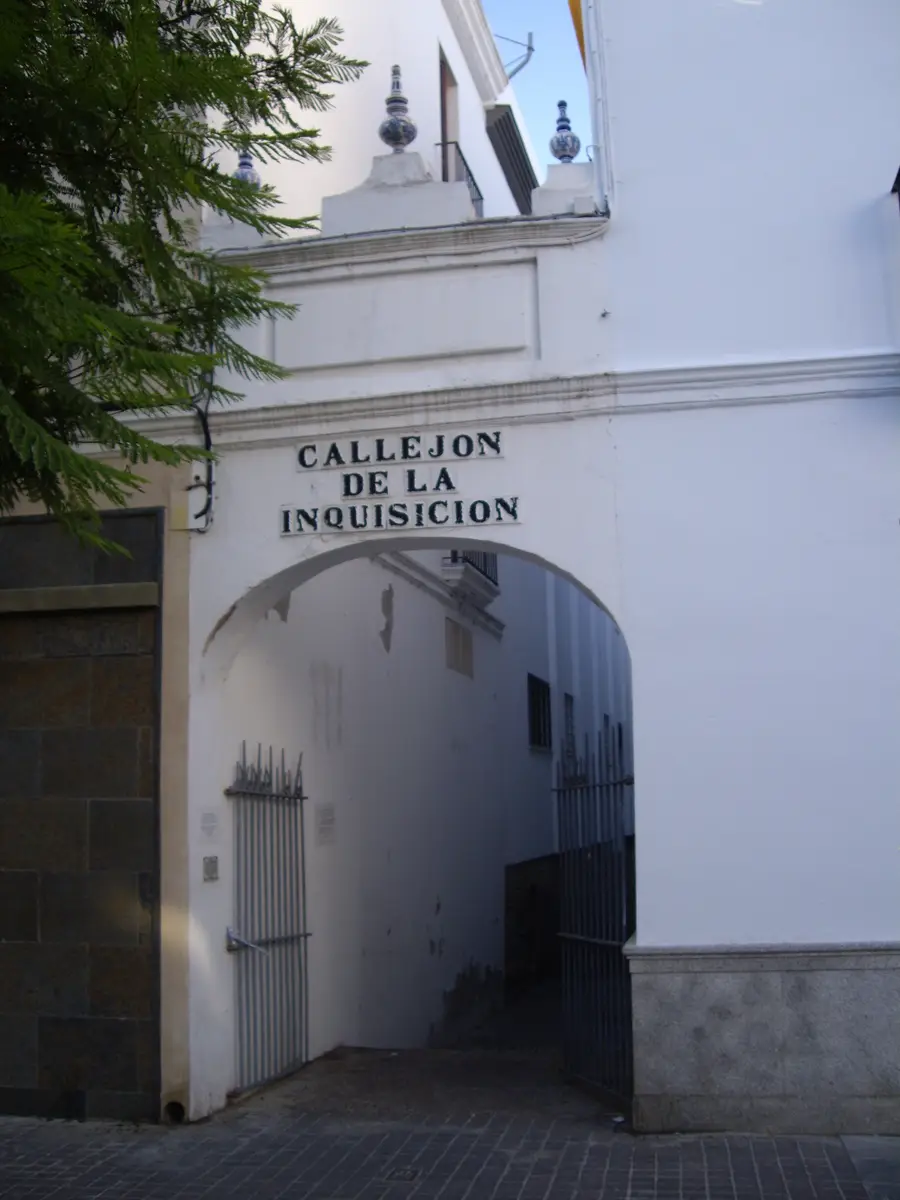
- Alley of the Inquisition (Callejón de la Inquisición). What it was: a narrow passage within the castle's precinct along which, according to the City Council's tourist map, prisoners were led to be tried. What remains today: the alley itself, with its name lettered above the entrance arch. Where: in Triana, between Calle Castilla and the Paseo de Nuestra Señora de la O, on the riverbank.
- Plaza de San Francisco. What it was: the stage of the great autos-da-fé, such as those of 1559 and 1624, to which prisoners were brought from the castle. What remains today: the square, in front of the City Hall, with the Mercury fountain where our private tour begins. Where: the historic centre, on the bank opposite Triana.
What does the Plaza de San Francisco have to do with the Inquisition?
It was the Inquisition's great stage. According to the route reconstructed by the researcher Juan Ruiz Jiménez for the Historical Soundscapes project, at the autos-da-fé of 1559 and 1624 the prisoners left the Castle of San Jorge, crossed the bridge of boats, went up through the Arenal and reached the Plaza de San Francisco, where the auto was held. Those condemned to death were then taken on to the San Diego quemadero, the burning place.
It is no coincidence that our private Jewish Quarter tour in Seville starts there, at the Mercury fountain in the Plaza de San Francisco: the story of Seville's Jews and conversos begins, without detours, in the Inquisition's square. The walk then heads into the old Jewish quarter, on the same bank; the Castle of San Jorge is not on the route, but you can cross to Triana on your own afterwards.
Frequently asked questions
Is the Castle of San Jorge free?
According to Visita Sevilla, the City Council's tourism website, admission to the Castle of San Jorge is free and needs no booking. As of mid-November 2026, however, the same official page lists the archaeological site as closed, with only the building's entrance hall open as a tourist office, so check there before you go.
What is underneath the Triana Market?
The remains of the Castle of San Jorge, the Almohad fortress that was the seat and prison of the Spanish Inquisition in Seville from 1481 to 1785. They came to light while the present market was being built, after the old one was demolished in 1990: the paving, walls of the inquisitors' houses and the space of the chapel survive, and since 2009 a municipal interpretation centre has displayed them.
Why is it called the Alley of the Inquisition?
Because it was part of the precinct of the Castle of San Jorge, the seat of the Inquisition in Seville. According to the City Council's tourist map, prisoners were led along this narrow passage to be tried by the tribunal. The Alley of the Inquisition is in Triana and links Calle Castilla with the Paseo de Nuestra Señora de la O, on the bank of the Guadalquivir.
What was an auto-da-fé?
A public ceremony at which the Inquisition's sentences were read; according to Encyclopaedia Britannica, the penalties were then carried out by the secular authorities. The Spanish Inquisition's first was held in Seville on 6 February 1481, with a procession to the Tablada and six people burned at the stake. The great later autos-da-fé, such as those of 1559 and 1624, were held in the Plaza de San Francisco.
Sources
- Visita Sevilla (Seville City Council) — “Castillo de San Jorge”: official page with current status, address and admission (consulted on 16 November 2026)
- Visita Sevilla — “St. George's Castle”: the tribunal from 1481 to 1785, its departure in 1626 and return in 1639, the demolition, the 1823 market and the 2009 interpretation centre
- Seville City Council — “Castillo de San Jorge. Guía de la visita” (visitor guide, PDF): the Almohad fortress, the Order of San Jorge, the convent of San Pablo, the cells, the 1785 move and the market
- Sevilla Turismo — “Triana”, free tourist map (PDF): the Castle of San Jorge as an archaeological site and the Alley of the Inquisition
- Seville City Council — “El Castillo de San Jorge reabre como el gran espacio expositivo del Arte Sacro en Sevilla” (the castle reopens as an exhibition space for sacred art), 5 March 2025
- Encyclopaedia Britannica — “Spanish Inquisition”: Sixtus IV's bull of 1478 and the harshness of the first inquisitors in Seville
- Encyclopaedia Britannica — “Auto-da-fé”: the ceremony, the carrying out of sentences by the secular authorities and the first auto-da-fé, in Seville in 1481
- Jewish Encyclopedia (1906) — “Inquisition”: the appointment of the first inquisitors (27 September 1480), the move to the castle of Triana and the auto-da-fé of 6 February 1481
- Ruiz Jiménez, J. (2025). “Itineraries of the Autos de Fe in Seville”. Historical Soundscapes.
- Delgado Ramírez, A. A. (2024). Casa Sefardí de Sevilla. Master's dissertation (Trabajo Fin de Máster), Universidad Pablo de Olavide, 2023/2024.
- Cover photo: Gzzz, “Castillo de San Jorge y Puente de Triana”, Seville, 2013. CC BY-SA 3.0, via Wikimedia Commons.
- Photo of the alley: CarlosVdeHabsburgo, “Callejón de la Inquisición”, Triana (Seville), 2013. CC BY-SA 3.0, via Wikimedia Commons.