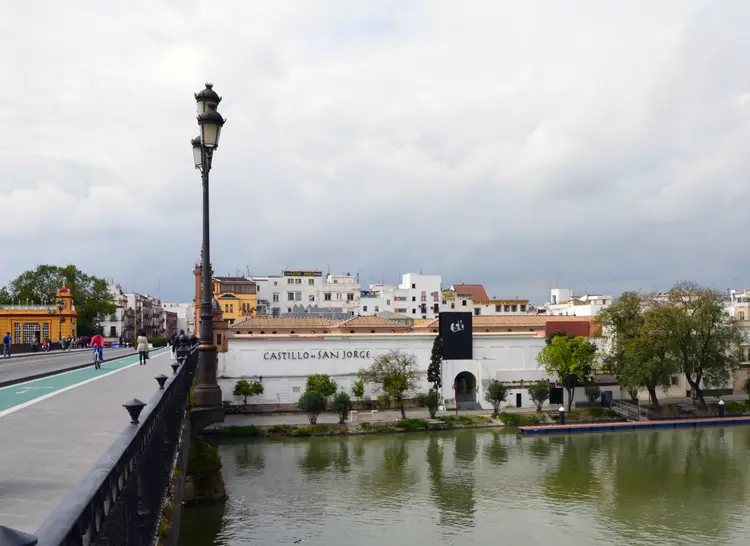
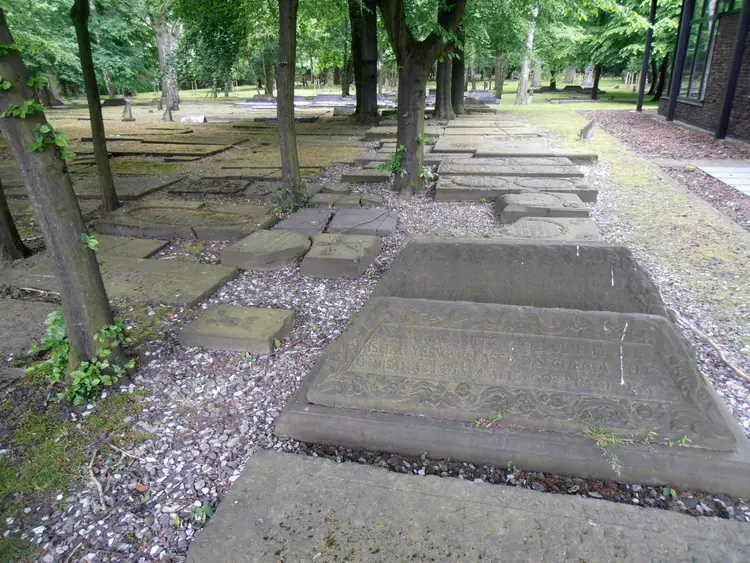
Every time a viral list of surnames does the rounds again, many people in Mexico, Colombia, Argentina or the United States ask themselves the same question: is my last name Sephardic? Seville is a good place to answer it. Castile's first Inquisition tribunal began working here in 1481, and the ships for the Indies sailed from here. This is the answer its archives give.
Is there a list of Sephardic surnames?
No. In February 2014, while the government was preparing the law on nationality for Sephardim, a list of surnames presented as official was circulating online; the press put it at more than 5,200 names. The Ministry of Foreign Affairs was blunt: “This list is false”, and none had been published or was going to be. Similar lists keep resurfacing on social media, often billed as “the 5,220 Sephardic surnames”.
The law that made this question famous was Law 12/2015, on Spanish nationality for Sephardim of Spanish origin. Its window for applications opened on 1 October 2015 and, after a one-year extension, closed on 1 October 2019. This article is not about nationality, but about what documents can prove.
Why did conversos have ordinary surnames?
Because they took them at baptism. After the attacks of 1391, which began in Seville, a much larger group of conversos emerged, and after the 1492 edict of expulsion, whoever stayed did so baptised. Baptism brought a Christian first name and, often, a new surname, the same kind their neighbours already bore.
The best-known case is that of Abraham Senior, chief rabbi of Castile, who was baptised in June 1492 and became Fernán Pérez Coronel. One of his sons was called Juan Pérez Coronel; another, baptised before 1492, Íñigo López Coronel, which according to some authors explains why he did not share his father's surname. Pérez and López, two of the most common surnames in Spain, in a single family of Jewish origin.
Nor did every Jew bear a Hebrew name. In 1477 the Catholic Monarchs ordered the aljama, the Jewish community of Seville, to accept Ana González, Ana Gonçales in the spelling of the time, as its butcher; she was a Jewish woman whose story is told in Room III of the Collection. Her surname is today the third most common in Spain.
That is why Rodríguez, López or Pérez turn up among conversos: they turn up among everyone. They are patronymics (Rodríguez means “son of Rodrigo”; Pérez, “son of Pedro”), and according to Spain's statistics office, the INE, Rodríguez is today the second most common surname in Spain, López the fifth and Pérez the eighth. Finding a converso with your surname says nothing about your family, because a great many Old Christians had exactly the same name.
Genealogists do speak of clues. Jaime de Salazar Acha groups them into five: social position, trade, the city where the family lived, marriages within the same group and certain surnames, such as those of saints, places or animals. But he does not treat them as conclusive: for him, only documentary proof can establish that someone was of Jewish origin, as the historian David Cuevas Góngora notes.
What can Seville's archives prove?
A great deal about a specific person, and nothing about a surname. These are the main sources for researching Seville's conversos and those who crossed to the Americas, with what each one holds and its limit:
- Archivo General de Indias. Where: in Seville, in the Lonja building beside the Cathedral. What it holds: the papers of the Council of the Indies and of the Casa de la Contratación, which granted licences to sail. What it can show: who applied to go to the Americas, where they came from and who travelled with them. Limit: its passenger records only cover those who left Seville legally.
- Catálogo de Pasajeros a Indias. Where: published from 1940 onwards in seven volumes. What it holds: the names in the passenger registers (Libros de asientos de pasajeros) from 1509 to 1599. What it can show: whether an ancestor sailed in the sixteenth century and where he or she came from. Limit: by a classic estimate, it covers around a fifth of those who emigrated.
- PARES, the Portal of Spanish Archives. Where: online, on the Ministry of Culture's website. What it holds: descriptions and images of documents from the Archivo General de Indias, the National Historical Archive, the General Archive of Simancas and other state archives. What it can show: a specific document, with its reference number, that you can cite. Limit: not everything is digitised or described name by name.
- Records of the Inquisition tribunal of Seville. Where: in the National Historical Archive in Madrid, Inquisition section. What it holds: what survives of the Seville tribunal between 1480 and 1834. What it can show: the trace of a specific person before the tribunal. Limit: it is only 33 bundles (legajos) for more than three and a half centuries of activity.
- Juan Gil, Los conversos y la Inquisición sevillana. Where: eight volumes published by the University of Seville and the El Monte Foundation between 2000 and 2003. What it holds: a prosopography, that is, a documented record of converso families and individuals in Seville from the fifteenth to the seventeenth century. What it can show: whether a specific person, with a name and a date, is recorded as a converso. Limit: it identifies people, not surnames; sharing a surname with one of them does not link you to their family.
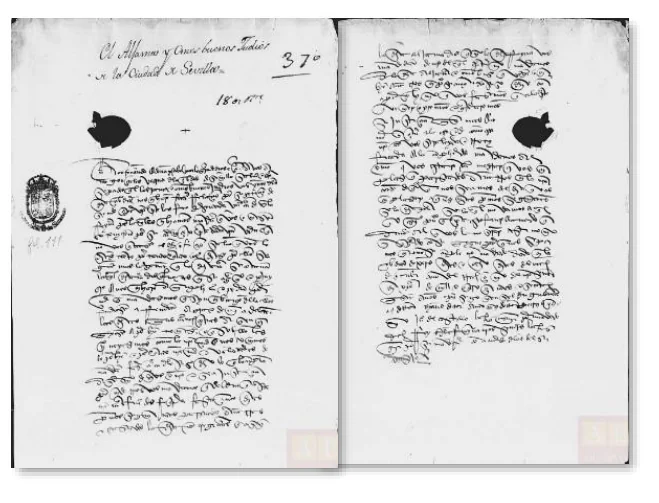
All these sources have something in common: they identify people with a name, a date and a place, not surnames. A Pérez in a document from 1490 is not your Pérez until a chain of documents, generation by generation, links that person to you.
How did Seville's conversos reach the Americas?
With a licence they were in theory not allowed to obtain, or outside the registers altogether. To sail for the Indies you needed a licence from the Casa de la Contratación in Seville, and from the start the Crown barred New Christians, that is, conversos, from going. Even so, recent studies show a significant presence of conversos in the expeditions of discovery and conquest and in the colonial period, as the historian David Cuevas Góngora sums up.
In the Inquisition and diaspora room of the virtual museum you will find some of those names: Gonzalo López Gavilán, a converso, fled to the Indies in 1534, and Juan de Loya escaped persecution to the Americas in 1535. The Inquisition later crossed the Atlantic too: it set up a tribunal in Lima in 1570, another in Mexico in 1571 and another in Cartagena de Indias in 1610.
It is the inquiries of those tribunals, not surnames, that reveal converso origins. In an inquisitorial visit of 1587 in the viceroyalty of Peru, Gonzalo Rodríguez Franco, from Málaga, came to light, with a proof of lineage acknowledging that on his mother's side he seemed to belong to the converso Franco family of Toledo. What gave him away was not the surname Rodríguez, but his mother's genealogy.
How do you start researching Sephardic ancestry?
Start with yourself and work backwards. The order matters, because each step gives you the name, the date and the place you need for the next one:
- Step 1, your recent family. What to look for: full names, dates and places for your parents, grandparents and great-grandparents. Where: family papers and your country's civil registry.
- Step 2, the colonial period. What to look for: baptisms, marriages and burials, generation after generation. Where: the parish registers of each town.
- Step 3, the voyage. What to look for: the ancestor who crossed the Atlantic and his or her place of origin in Spain. Where: the Catálogo de Pasajeros a Indias and the Contratación section of the Archivo General de Indias, on PARES.
- Step 4, the Inquisition. What to look for: trials, testimonies or proofs of “purity of blood” under that name. Where: the Inquisition section of the National Historical Archive and the records of the tribunals of Lima, Mexico and Cartagena de Indias.
- Step 5, the literature. What to look for: whether that person or their family is recorded as converso in published studies. Where: works such as Juan Gil's for Seville and academic history journals.
If the chain breaks at any point, the surname will not mend it. And if you reach a document that names your ancestor as a converso, you will have something no list on the internet can give you: proof.
Frequently asked questions
Is Rodríguez a Sephardic last name?
Not on its own. Rodríguez is a patronymic, “son of Rodrigo”, and today the second most common surname in Spain according to the INE. Conversos bore it, such as Gonzalo Rodríguez Franco from Málaga, whom an Inquisition visit of 1587 in Peru linked through his mother to the Franco family of Toledo, and a great many Old Christians bore it too. Only a chain of documents can link your family to a converso.
Is Pérez a Jewish surname?
No. Pérez means “son of Pedro” and is today the eighth most common surname in Spain according to the INE. Some Jews took it when they were baptised: Abraham Senior, chief rabbi of Castile, became Fernán Pérez Coronel in June 1492. But a converso called Pérez does not make the surname Jewish.
How can I prove Sephardic ancestry?
With documents, not surnames: a chain of civil and parish records that takes you back, generation by generation, to an ancestor who appears as a Jew or a converso in a source of the period, such as an Inquisition trial, a proof of “purity of blood” or a documented study such as Juan Gil's on the conversos of Seville.
Where can I find the records of passengers to the Indies?
In the Archivo General de Indias in Seville, Contratación section: the passenger registers, or Libros de asientos de pasajeros (1509-1701), and the files of informaciones y licencias (1534-1790). Many documents can be viewed online on PARES, and the Catálogo de Pasajeros a Indias publishes the names from 1509 to 1599.
Sources
- Law 12/2015 of 24 June on the granting of Spanish nationality to Sephardim of Spanish origin. Boletín Oficial del Estado no. 151, 25 June 2015.
- Order PRA/325/2018 of 15 March, publishing the Council of Ministers' agreement of 9 March 2018 that extended the application deadline of Law 12/2015 to 1 October 2019. BOE, 27 March 2018.
- Spanish Ministry of Foreign Affairs, Embassy of Spain in Panama — “Anteproyecto de ley para agilizar la concesión de la nacionalidad española a los sefardíes”, 17 February 2014 (notice that the list of surnames is false)
- Vanguardia (Colombia) — “La lista de apellidos para obtener el pasaporte español es falsa” (the list of surnames for a Spanish passport is false), 27 March 2014
- Spain's National Statistics Institute (INE) — “Apellidos 2025: más frecuentes de los residentes en España” (most frequent surnames of residents in Spain), infographic, April 2026
- Real Academia de la Historia, Historia Hispánica — “Íñigo López Coronel”, son of Abraham Seneor (Fernán Pérez Coronel)
- General Archive of Simancas, Registro General del Sello, leg. 147711, fol. 234 (1477): letter to the Jewish aljama of Seville to accept Ana González as its butcher (PARES)
- San Mamés Albar, R. (2020). “La carnicera judía Ana Gonçales en el contexto de la Sevilla bajomedieval”. Anales de la Universidad de Alicante. Historia Medieval, 21, pp. 225-242.
- Cuevas Góngora, D. (2021). “Judeoconversos en América: estudio de caso del malagueño Gonzalo Rodríguez Franco, uno de los descubridores de las islas Salomón”. Baetica. Estudios de Historia Moderna y Contemporánea, 41, pp. 139-168.
- Andreo García, J. and Provencio Garrigós, L. (1990-1991). “Pasajeros a América: aportación al estudio de la emigración del Reino de Murcia durante el s. XVI”. Anales de Historia Contemporánea, 8.
- Archivo General de Indias (Spanish Ministry of Culture) — “Fondos documentales. Introducción”: the origin of the records it holds
- National Historical Archive, Inquisition section — fonds “Tribunal de la Inquisición de Sevilla”, 1480-1834, 33 legajos (PARES)
- Gil, J. (2000-2003). Los conversos y la Inquisición sevillana. 8 vols. Seville: University of Seville and El Monte Foundation.
- Delgado Ramírez, A. A. (2024). Casa Sefardí de Sevilla. Master's dissertation (Trabajo Fin de Máster), Universidad Pablo de Olavide, 2023/2024.