Many organised trips through Jewish Spain spend several days between Toledo, Córdoba and other Jewish quarters, and leave Seville just one. This guide is for that day: why Seville matters in the history of Sepharad, what to see and in what order, and what is worth reading before you arrive.
The day at a glance
- Morning (from 10:00): the old Jewish quarter on foot, from Plaza de San Francisco to Plaza de Santa Cruz.
- Midday (11:30): inside Santa María la Blanca, the former synagogue.
- Afternoon: Triana and the Castillo de San Jorge, the first seat of the Inquisition in Castile.
- Evening: the Guadalquivir, the port some fifty thousand people left from in 1492.
Why does Seville matter on a Jewish heritage trip?
- 1248 — After the Christian conquest, Alfonso X gives the aljama three mosques to turn into synagogues and walls the quarter: the Judería is born.
- 1391 — The pogrom preached by Ferrán Martínez destroys Seville's Jewish quarter: it is the first of a wave that sweeps the whole peninsula.
- 1478–1481 — Seville is the first city in Castile with a tribunal of the Inquisition, seated in the Castillo de San Jorge, in Triana.
- 1492 — After the expulsion edict, some fifty thousand people leave the port of Seville on Genoese and Basque ships; with them travels the Castilian that will become Ladino.
- 2026 — Seville rejoins the Red de Juderías de España – Caminos de Sefarad.
Morning: the old Jewish quarter
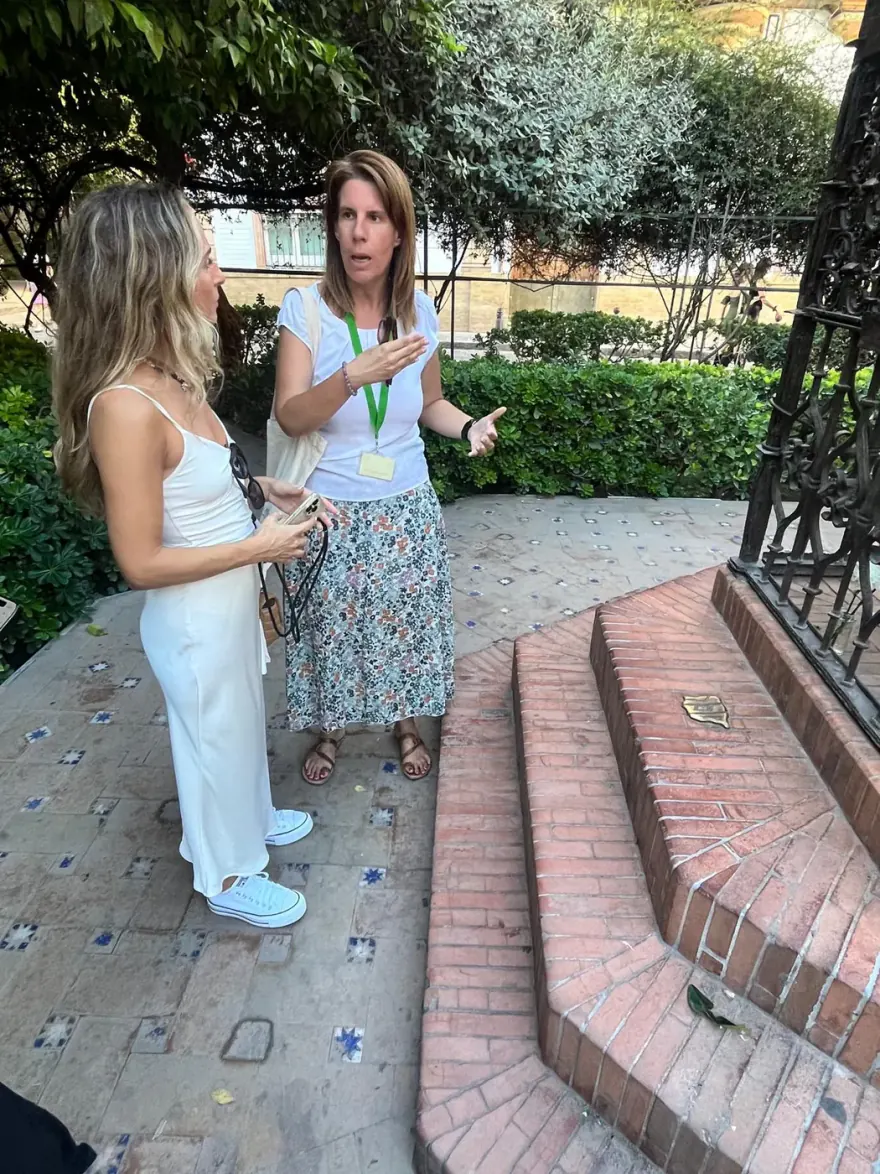
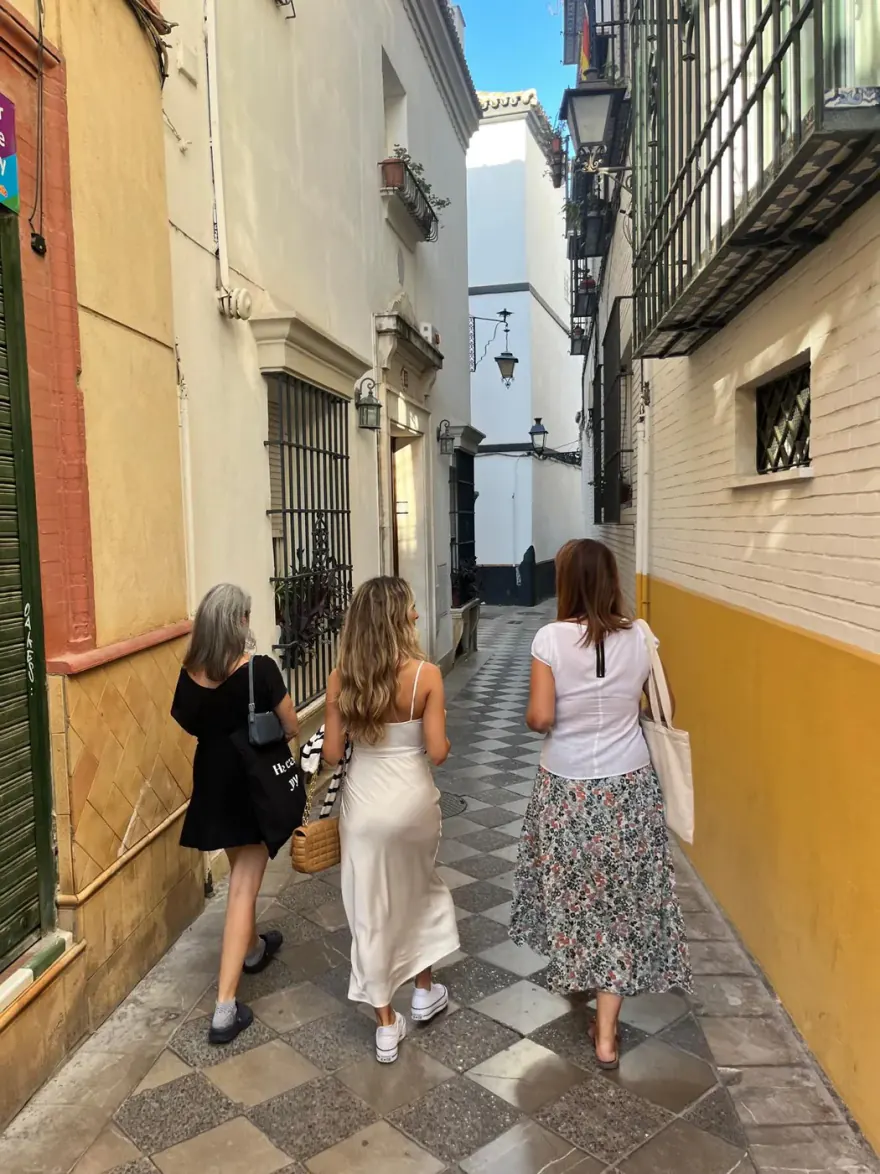
Start in Plaza de San Francisco and walk the six stops of the Jewish quarter: the wall on Calle Fabiola, San Bartolomé, Santa María la Blanca, the Murillo Gardens — with the necropolis beneath them — and Plaza de Santa Cruz, where the main synagogue stood. You can do it on your own by following our stop-by-stop route, or with a guide: our guided route departs every hour from 10:00 and takes two hours.
Midday: inside Santa María la Blanca
Santa María la Blanca is the only one of Seville's three former synagogues with visible remains; today it is a church. One version of our guided route includes a visit inside, departing at 11:30 and 17:30 from Plaza Virgen de los Reyes. If your day starts late, the 17:30 departure fits after Triana.
Afternoon: Triana and the Castillo de San Jorge
Cross the Guadalquivir to Triana. Beneath the Triana market lie the remains of the Castillo de San Jorge, where the tribunal of the Inquisition that began to act in 1481 was installed; today it houses an interpretation centre on the Inquisition. This is where the story of the Jewish quarter continues after 1391: the story of the conversos. We tell it in the room Inquisition and diaspora of the virtual museum.
Evening: the river of 1492
End the day by the Guadalquivir. From this river port some fifty thousand people left in 1492, on Genoese and Basque ships, most of them to North Africa and some to today's Turkey. They took with them the Castilian of the fifteenth century, which mixed with Hebrew and Turkish and became Ladino. The full story is in 1492: the edict, the port of Seville and the birth of Ladino.
What should you read before you arrive?
Two things, both free and online. The Jewish quarter in five dates, with the map of the walled enclosure, and the six rooms of the collection, which you can visit from anywhere, at any time. Arriving knowing what each place was changes what you see in the street.
Is there a synagogue in Seville today?
Seville's Jewish community is small: it has a private synagogue and an Orthodox organisation, the Comunidad Judía de Sevilla. It is not a place for tourist visits. The historic synagogues you will see on the route are churches today: Santa María la Blanca and San Bartolomé, while that of Santa Cruz disappeared in the nineteenth century.
How does Seville fit with Toledo and Córdoba?
Since 1 January 2026 Seville has again been a full member of the Red de Juderías de España – Caminos de Sefarad, alongside cities such as Córdoba, Toledo, Segovia, Ávila, Lucena, Jaén, Cáceres and Ribadavia. Seville's Jewish quarter is not Córdoba's or Toledo's: fewer of its buildings are still standing, but it is the city where the attacks of 1391 began, where Castile's first Inquisition was installed and from whose port the expulsion set sail. Seen alongside the others, Sepharad becomes one story.
Frequently asked questions
How many days do you need in Seville for its Jewish history?
One full day is enough for the essentials: the Jewish quarter in the morning, Santa María la Blanca at midday and Triana in the afternoon. With more time, the six rooms of the virtual museum expand on each place from the documents.
Where is the Castillo de San Jorge?
In Triana, across the Guadalquivir: its remains lie beneath today's Triana market. It was the seat of the Inquisition tribunal that began to act in 1481, and today it houses an interpretation centre on the Inquisition.
Where did the Jews expelled from Seville go in 1492?
Most went to North Africa, and some to today's Turkey. Some fifty thousand people left the port of Seville on Genoese and Basque ships.
What is Ladino?
The language of the Sephardim: the fifteenth-century Castilian the exiles took with them, mixed with Hebrew and Turkish. It has survived to this day in the Sephardic diaspora communities of the former Ottoman Empire.
Sources
- Delgado Ramírez, A. A. (2024). Casa Sefardí de Sevilla. Trabajo Fin de Máster, Universidad Pablo de Olavide, curso 2023/2024.
- Montes Romero-Camacho, I. (1987). «Notas para el estudio de la judería sevillana en la Baja Edad Media (1248-1391)». En la España Medieval, 10, pp. 343-366.
- San Román, P. «Ladino, una lengua 'castellana' que lucha por sobrevivir». Carta de España, Ministerio de Inclusión, Seguridad Social y Migraciones.
- Red de Juderías de España – Caminos de Sefarad (web oficial).