Santa Cruz and San Bartolomé tell us about everyday life in medieval Jewish Seville. Yet its story also involves the royal court, religious institutions and the changing city. These histories extend far beyond a single neighborhood.
Can a Jewish Quarter tour include the Royal Alcázar?
Yes. The Royal Alcázar was the seat of the royal power that reorganized Seville after the Christian conquest of 1248, and within its walls three places are tied to the city's Jewish history:
- Gothic Palace. What it is: the palace from the time of Alfonso X. Jewish link: Alfonso X is the king who gave the Jewish community three former mosques to adapt as synagogues.
- Mudéjar Palace. What it is: the palace of Pedro I, from the mid-14th century. Jewish link: Pedro I's chief treasurer was the Jewish courtier Samuel Leví, who built the El Tránsito synagogue in Toledo.
- Patio de los Levíes. What it is: a courtyard in the Alcázar with a four-arched Renaissance gallery. Jewish link: the gallery comes from the house of the Levíes, which stood in the old Jewish Quarter.
We tell the story of Samuel Leví, from Pedro I's court to the Toledo synagogue, in the room Historical figures of the virtual museum.
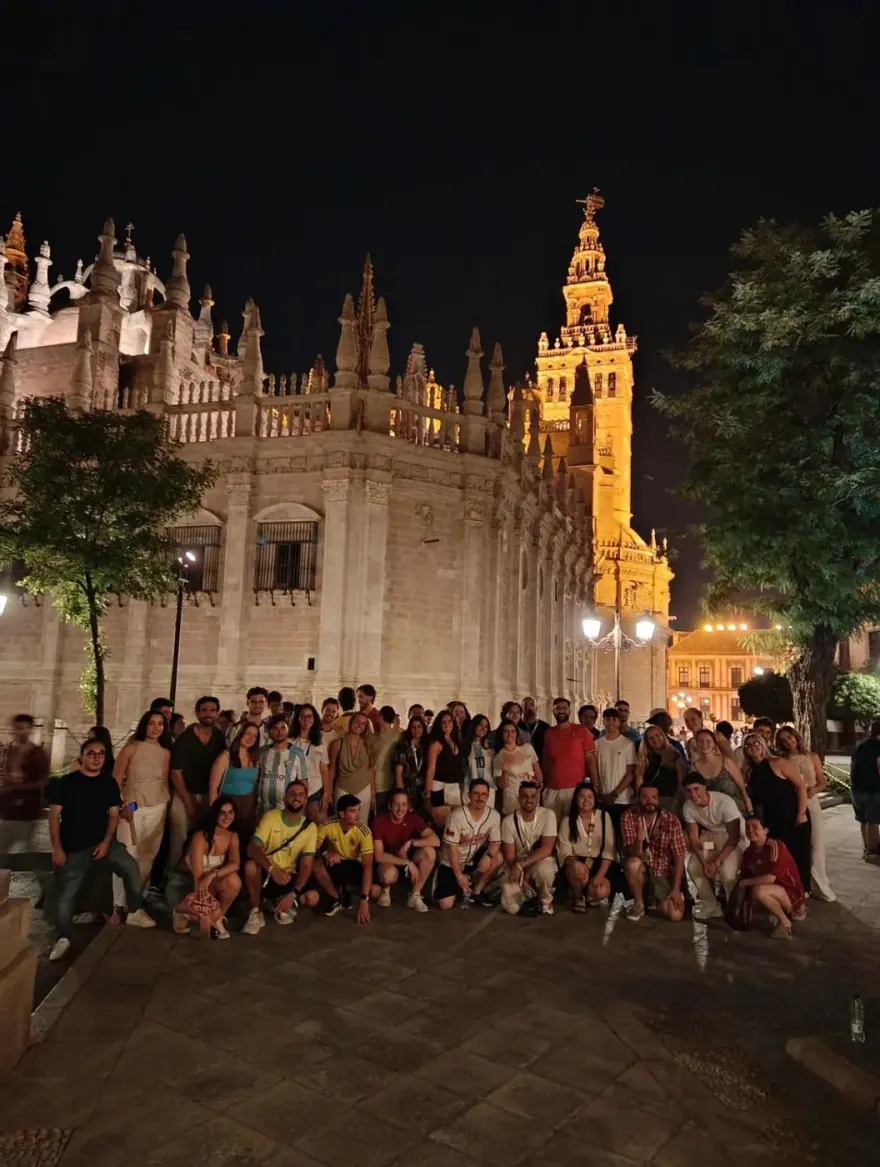
What does Seville Cathedral have to do with Jewish history?
Seville Cathedral was not a synagogue. It stands on the former Almohad great mosque, whose minaret survives as the Giralda. However, its history helps visitors connect the conquest of 1248 with later religious change, the violence of 1391, conversions and the Inquisition.
There is also a specific link. In the Chapter House, among the eight Sevillian saints that Murillo painted in 1667–1668 around his Immaculate Conception, is Saint Isidore of Seville. This Visigothic-era bishop wrote «De fide Catholica contra Iudaeos» (On the Catholic Faith against the Jews), an anti-Jewish polemical treatise, in the early seventh century; a codex of that work can be seen in the room Origins of the virtual museum.
Is Casa de Pilatos connected to Jewish history?
Casa de Pilatos should not be described as a Jewish monument either. It is an aristocratic palace with Mudéjar and Renaissance features. A combined tour can examine elite families, patronage, religious identity and social change in the fifteenth and sixteenth centuries.
Its origin, however, is tied to the conversos. In September 1483, Catalina de Ribera bought a property the Inquisition had confiscated from Pedro López and Francisca de Herrera, a married couple condemned for heresy; he, a city official, was of Jewish origin. The property lay in the parish of San Esteban, and once its buildings were pulled down the new house began to rise there. It was never a synagogue, but the palace was born from property seized from a converso family.
Beyond Jewish history: other Altai Turismo experiences
Altai Turismo offers much more than Jewish history. Its licensed guides lead private visits to the Alcázar and Cathedral, introductory Seville walks, women's history tours, Islamic Seville, Itálica and cultural visits to Córdoba. Guiding is available in English and Spanish. Themes may be combined if timing, tickets and distances permit.
Three ways to combine historical tours
- Jewish Quarter + Royal Alcázar. What you understand: the royal power that reorganized Seville after 1248 and the medieval world around the Jewish community. Tickets: included, subject to availability.
- Jewish Quarter + Cathedral and Giralda + Alcázar. What you understand: the widest picture, from the Almohad great mosque to 1391, the conversions and the Inquisition. Tickets: included, subject to availability.
- Jewish Quarter + Casa de Pilatos. What you understand: the shift from medieval to Renaissance Seville, with the elites and patronage of the 15th and 16th centuries, and a palace born from property confiscated from conversos. Tickets: ask when you book.
These are not fixed packages: you can suggest your own theme or add women's history, art and other monuments. There is no fixed length; you agree it with the guide before the tour.
How can you arrange a custom private Seville tour?
To plan your tour, share the monuments you want to see, available time, date and group size. Altai Turismo can help evaluate realistic itineraries, entry tickets and pricing. Not every combination is possible on every date; arrangements must be confirmed before booking.
Explore the range of historical tours and contact Altai Turismo to create your personal itinerary. Casa Sefardí's virtual collection remains free to explore.
Frequently asked questions
Are tickets to the Alcázar and the Cathedral included?
Yes: on combined tours with the Alcázar or the Cathedral, tickets are included in the price. What must be checked first is that tickets are still available for your date, because they can sell out, so ask well in advance, before you settle on a date.
How long does a combined tour last?
There is no fixed length. You agree it with the guide before the tour, depending on the monuments you want to see and the time you have.
How much does a combined tour cost?
There is no set rate: it is quoted according to the itinerary. Write to Altai Turismo's customer service by WhatsApp or email with the monuments, the date and your group size, and they will tell you the price.
And if I only want the Jewish Quarter route?
That is the Jewish History of Seville route: a private 2-hour tour just for your group, of up to 7 people, for €176.40 in total, Monday to Saturday, in English or Spanish. It is booked online on the Tours page.
Sources
- Delgado Ramírez, A. A. (2024). Casa Sefardí de Sevilla. Trabajo Fin de Máster, Universidad Pablo de Olavide, curso 2023/2024.
- Montes Romero-Camacho, I. (1987). «Notas para el estudio de la judería sevillana en la Baja Edad Media (1248-1391)». En la España Medieval, 10, pp. 343-366.
- Real Alcázar de Sevilla, «Historia». Official website of the Real Alcázar.
- Real Alcázar de Sevilla, «Patio de los Levíes». Google Arts & Culture.
- Catedral de Sevilla, «La Giralda». Official website of the Cathedral.
- Catedral de Sevilla, «El Patio de los Naranjos, antiguo sahn de la mezquita». Official website of the Cathedral.
- Babío, A. R. (2025). «San Leandro de Sevilla. Sala Capitular de la Catedral de Sevilla». Archidiócesis de Sevilla.
- Aranda Bernal, A. (2011). «El origen de la Casa de Pilatos de Sevilla. 1483-1505». Atrio, 17, pp. 133-172.
- Fundación Casa Ducal de Medinaceli, «Casa de Pilatos». Official website of the foundation.